Get email alerts on the Speed Limits topic
No spam. Unsubscribe anytime.
Staff urges city code changes to allow lowering speed limits based on safety rubric
Summary
Transportation staff proposed removing default 25 mph language from city code and delegating authority to the city engineer with a rubric that accounts for pedestrians, transit, and design speeds; staff estimated about 75% of streets could be changed quickly while some corridors (e.g., 5th Street) will need engineering work.
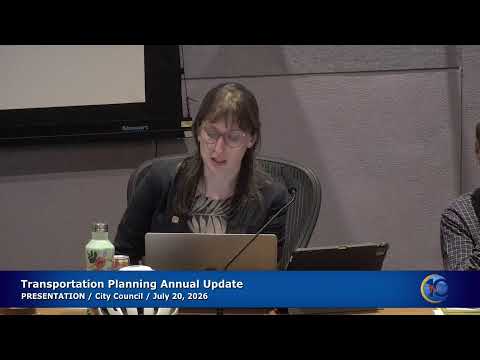
Ben Chambers told council that posted speed limits in Charlottesville are frequently higher than design speeds in the city's 'Streets That Work' guidance and that federal rule changes in 2024 broadened criteria for setting limits to include pedestrian presence and transit stops.
"Most of the speeds we have today are much higher than what those design speeds are," Chambers said, noting local streets are typically posted at 25 mph while design guidance recommends 20 mph. He described a proposed approach to change the city code to allow the city engineer to set speed limits using a rubric that references local plans, federal guidance and safety considerations rather than the current blanket 25-mph default.
Chambers said some streets will be straightforward to adjust by changing signs, while others will require infrastructure work first. "We're thinking that that bucket of get it done fast is much larger than the don't get it done fast bucket. Like, 75% of the streets would be in the get it done bucket," he said. Councilors asked about sequencing and safety on complex corridors such as 5th Street; staff replied that those will be addressed through the mobility plan and corridor-specific engineering.
AI generated
The text on this page is AI generated. Summaries, highlights, analysis, and video transcripts are all produced from the original source material.
AI can make mistakes, so if you spot one, and we will fix it for everyone.
Note: the source content is unaltered by us. Any content source we link to, be it a video, an audio recording, or a document, is presented exactly as its publisher released it. That publisher is usually a government body, sometimes an individual official or another organisation.