Get Full Government Meeting Transcripts, Videos, & Alerts Forever!
Get email alerts on the Tax Policy topic
No spam. Unsubscribe anytime.
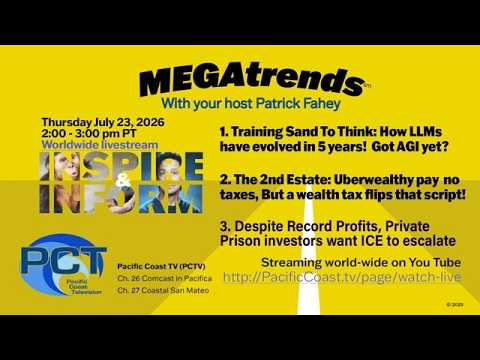
Scholar calls richest Americans a modern "2nd estate" and outlines how a wealth tax could raise trillions
Summary
Ray Madoff, identified on the Megatrends episode as a Boston College Law professor, described wealth-concentration mechanisms he calls a "2nd estate," outlined how estate-tax erosion and stock buybacks reduce tax revenues, and cited figures for federal receipts, spending, and wealth totals to argue wealth taxes could fund major social programs.
On the July 23 Megatrends episode, Ray Madoff (introduced and self-identified in the segment) described what he called a modern "2nd estate" of ultra-wealthy Americans who largely avoid federal taxes. Madoff summarized national-level fiscal figures and structural tax dynamics: "It's how the government raised a total of $5,000,000,000,000" in receipts while spending about "$6,800,000,000,000," leaving a shortfall he identified as roughly $1.8 trillion. He contrasted that deficit with an estimated total wealth held by the richest Americans of approximately "$46,000,000,000,000," arguing that avoidance mechanisms—capital-gains treatment, estate-tax loopholes, and charitable deductions—shield wealth from taxation.
Madoff walked through mechanisms he sees as compounding the effect: stepped-up basis and exclusion of unrealized gains, charitable donations that can defer or reduce tax exposure, and stock buybacks after rule changes that shifted corporate profit distribution. He said the estate tax "is supposed to impose a tax of 40% on all transfers" but noted the law has gone largely unchanged since 1990 and yields little revenue as a result. He added that proposed wealth taxes (several proposals were mentioned) could raise large sums; the program cited a version of a Sanders plan projected at roughly $4.4 trillion over 10 years. Madoff framed potential spending priorities for a wealth tax: bolstering Social Security, expanding Medicare benefits, childcare, housing supports, and public infrastructure.
The show did not present legislative text or implementation timelines; the segment is an explanatory presentation of policy arguments and arithmetic rather than a record of enacted law. Figures cited in the segment come from the speaker's summary; readers should consult primary budget and revenue analyses for precise modeling assumptions.