Get Full Government Meeting Transcripts, Videos, & Alerts Forever!
Get email alerts on the Corporate Yard topic
No spam. Unsubscribe anytime.
Council reviews phased replacement plan for Glendora corporate yard with $13.6 million estimate
Summary
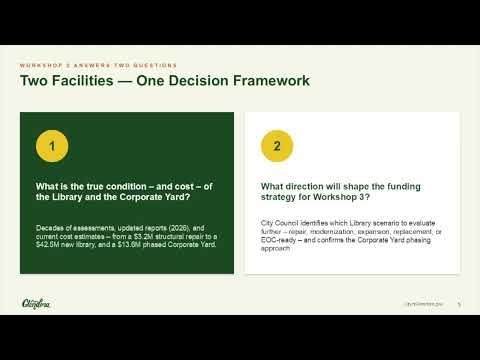
Staff indicated the corporate yard is functionally obsolete and recommended demolition and reconstruction across a phased campus; IDS's current phased estimate is approximately $13.6 million, with deferred maintenance of about $2.12 million identified.
City staff presented a multi‑decade operational case for replacing the corporate yard rather than repeatedly renovating constrained, aging buildings.
Moises Lopez said the yard, established in the 1960s on about 2.8 acres, has operational constraints from easements and layout and houses roughly 8,270 square feet of building area. A citywide facilities assessment identified about $2,120,000 in deferred maintenance there and IDS concluded demolition and replacement of several buildings with about 18,310 square feet of purpose‑built space would be more practical and cost‑effective over time. "The proposed project is not intended to create new municipal services. It replaces obsolete facilities so that existing services can be delivered more safely and efficiently for the future," Lopez said.
Council and members of the public discussed phasing, temporary operations and potential relocation alternatives (including the equestrian center) and recognized tradeoffs: phasing preserves service continuity but increases escalation and mobilization costs. Staff said the 2024 preliminary estimate was about $12.6 million and the current phased estimate is approximately $13.6 million, subject to escalation and sequencing assumptions.
Speakers with operations experience urged prioritizing employee facilities and operational continuity. Dwight Richards, a former Fairplex executive, highlighted efficiency and lifecycle benefits of modern facilities and encouraged exploring practical construction types and outside funding models.
Council asked staff to identify phase‑one priorities that stabilize operations and to include phasing and funding assumptions in the next workshop.