Get Full Government Meeting Transcripts, Videos, & Alerts Forever!
Get email alerts on the Hazard Mitigation topic
No spam. Unsubscribe anytime.
Keystone Heights council adopts Clay County mitigation strategy to remain eligible for state and federal hazard funds
Summary
Council voted to adopt Resolution 2026-15, formally accepting Clay County's updated Local Mitigation Strategy so the city remains eligible for FEMA and state hazard-mitigation funding. Officials said the plan is largely county-led but asked that local projects be added to the list.
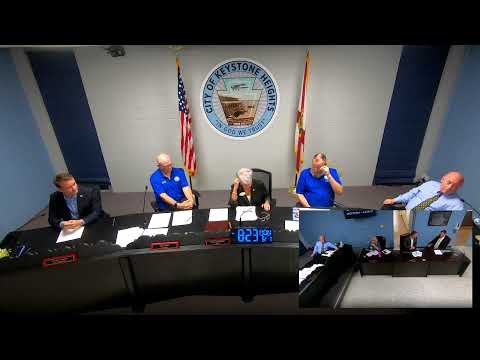
Keystone Heights'City Council voted June 1 to adopt Resolution 2026-15, formally accepting Clay County's 2025 Local Mitigation Strategy (LMS) so the city can continue to qualify for state and federal hazard-mitigation programs.
Clay County's emergency management director told the council the LMS documents historic disasters and lists projects countywide; municipalities must adopt the plan by resolution so the county can pursue Hazard Mitigation Grant Program funding on their behalf. "The committee meets, scores shovel-ready projects, and places them on the list so when funding becomes available they can be prioritized," the presenter said during the meeting.
Council members pressed for clarity on local impacts. One council member noted the LMS lists roughly 806 parcels countywide and said 146 of those in the county study fall inside a 100-year floodplain in the city. The presenter said Keystone currently has two state projects on the county list (State Road 100 traffic-signal and a related state road project) and encouraged staff to submit additional local stormwater projects for scoring.
A motion to adopt the resolution was made and seconded. After a brief discussion about the list and possible shovel-ready local projects, the council approved the resolution; the motion carried. City Manager James Booth said the adoption preserves the city's access to mitigation funds that can be used for drainage, culvert and stormwater projects and urged residents to consult the county GIS portal for updated flood-zone maps.
Looking ahead, council members asked staff to follow up on whether local projects were properly reflected in the LMS and to coordinate with Clay County staff on project scoping and grant readiness.