Get Full Government Meeting Transcripts, Videos, & Alerts Forever!
Get email alerts on the Public Safety topic
No spam. Unsubscribe anytime.
Raleigh County Police report low crime, staffing near capacity and flat-budget goal for 2026
Summary
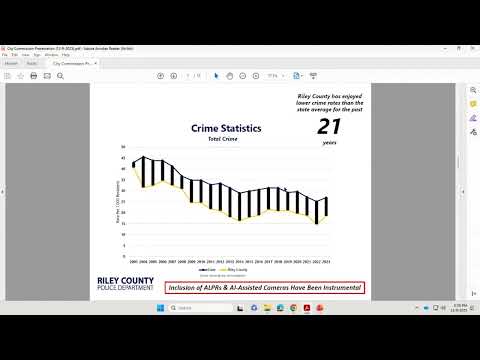
Director Brian Pete told the Manhattan commission that Riley County crime rates remain below Kansas averages, the department is nearly fully staffed and that his priority for 2026 is holding the operating budget flat while seeking grants for new equipment.
Brian Pete, director of the Raleigh County Police Department, gave a year-end state-of-the-department briefing that emphasized staffing stability and below-average crime rates. He said the department currently has 110 sworn officers of an authorized 113 and 104 civilian employees of 111, for about 214 of 224 authorized positions. "Crime remains low in Manhattan," Pete said, and he described a continued focus on succession planning and leadership training to sustain those staffing levels.
Pete walked through 2024 counts and per-1,000 rates, saying the department reported about 198 violent crimes (2.8 per 1,000), roughly 1,216 property crimes (14.2 per 1,000) and a total near 1,222 incidents (about 18.8 per 1,000). He noted that reporting methodology matters: the department submits data through the National Incident Based Reporting System (NIBRS) and excludes incidents that occur on Fort Riley or on the Kansas State University campus because those jurisdictions use other law-enforcement agencies. "Fort Riley is a federal installation. We have no jurisdiction there," Pete said, noting that excluding those populations modestly suppresses the county rate but does not change the overall picture that Riley County remains below the state average.
Pete said narcotics concerns center on fentanyl and methamphetamine, with cocaine re-emerging in some areas, and that traffic crashes have risen in recent months—traffic stops went from 621 in October to 702 in November—prompting targeted enforcement coupled with education, particularly in Aggieville. He described strategic 2026 priorities: maintaining a flat operating budget while pursuing external grants for equipment; advancing technology to improve data handling; and continued emphasis on training for critical-response teams.
On community programs, Pete described a reintegration coordinator funded by the special alcohol tax fund to help people exiting custody obtain driver's licenses, birth certificates and job-related credentials. He also said the department is working with the homelessness task force on a shared communications platform (JELADA) to coordinate services and divert people from unnecessary arrests. The director recommended continued coordination with county partners on facilities and with the public on ordinance definitions related to loitering and camping.
The commission and members of the public asked clarifying questions about methodology, staffing metrics and a proposed substation move; Pete said the county controls facility siting and that conversations about a substation relocation are ongoing and will require follow-up.