Get Full Government Meeting Transcripts, Videos, & Alerts Forever!
Get email alerts on the Geothermal topic
No spam. Unsubscribe anytime.
Darcy Solutions outlines aquifer-based geothermal option for Minnetonka buildings
Summary
A representative from Darcy Solutions told the Minnetonka Sustainability Commission that aquifer-based geothermal systems can fit tight urban sites, deliver high efficiency and long equipment life but come with higher upfront costs that rely on federal tax credits to close the gap.
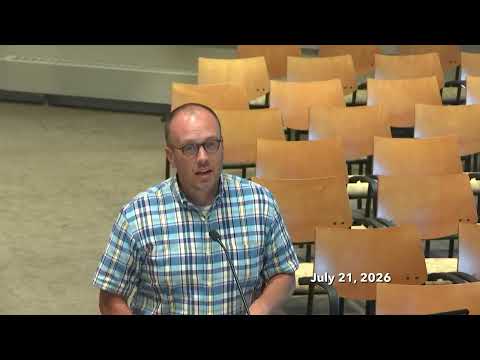
Robert Adam, director of marketing and strategy at Darcy Solutions, presented commercial-scale geothermal technology to the Minnetonka City Sustainability Commission on July 21, describing a well-based system that uses a heat exchanger lowered into a municipal-grade water well to provide building heating and cooling.
"We build advanced systems that allow for large production of thermal capacity in buildings for heating and cooling," Adam said, explaining Darcy's approach of placing heat exchangers at the bottom of 12-inch municipal wells and using submersible pumps to move aquifer water across the exchanger. He described components and typical dimensions — a 20-foot heat exchanger, submersible pumps in the 5-to-25-horsepower range — and said the systems can be engineered to serve both new construction and retrofits.
Adam said the company's systems are designed to fit small footprints where traditional bore fields would require large land areas. He estimated geothermal systems can deliver coefficients of performance (COPs) in the range of about 3 to 8 depending on season, and noted their long service life: "Geothermal systems last 50 to 100 years," he said, arguing that long-term total cost of ownership offsets higher initial capital costs.
Commissioners asked practical questions about land needs, sizing tradeoffs between heating and cooling, integration with domestic hot water and project timelines. Adam said drilling and well construction typically take about a month per well, and that engineering choices (optimizing for a heating-dominated load versus balanced heating/cooling) affect the number of wells and up-front cost. He also advised that the federal investment tax credit for geothermal is available through 2033 and can significantly reduce first costs when prevailing wages and domestic-content criteria are met.
The presentation included case examples of Darcy projects in K—2 through higher education, healthcare settings and affordable housing, and Adam invited commissioners to request site tours. The commission did not take an action vote on the technology; the session was informational only.