Get Full Government Meeting Transcripts, Videos, & Alerts Forever!
Get email alerts on the Private Sector Operations topic
No spam. Unsubscribe anytime.
Operators defend safety practices, remote oversight and rapid-response teams in San Jose webinar
Summary
Representatives from Coco, Serve/Servo and DoorDash described autonomy levels, field response teams, obstruction reporting and features intended to improve predictability and accessibility while emphasizing testing and local field operations.
Representatives from three operator companies described how their systems work and how they respond to incidents.
Carl (Coco) said Coco collects sidewalk-obstruction data and shares anonymized location reports with accessibility apps and city partners to improve routing and safety. "We do now share with BlindSquare ... one of the main apps for the visually impaired community," he said. Coco described field operations teams staged locally to respond within about 30 minutes.
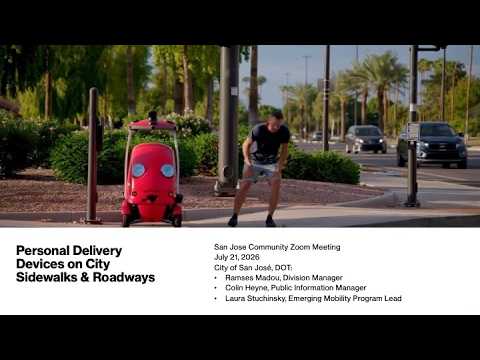
Kelly Jones (Serve/Servo Robotics) said her company's robots operate at about a walking pace (3–5 mph) on sidewalks, have blinking lights and multiple contact methods (phone, QR code, Braille) and that their autonomy is level 4 with human oversight available for dynamic scenarios. DoorDash's representative said their larger 'Dot' device has turn indicators, audio cues, and a validated top speed of 20 mph for certain roadway operations but that nominal behavior in bike lanes will be slower and designed to be predictable. All three companies said they do not run facial-recognition software on devices and that video is used internally for training and incident review.