Get Full Government Meeting Transcripts, Videos, & Alerts Forever!
Get email alerts on the Comprehensive Plan topic
No spam. Unsubscribe anytime.
Planning staff presents screening of 186 parcels to guide Breckenridge comprehensive plan
Summary
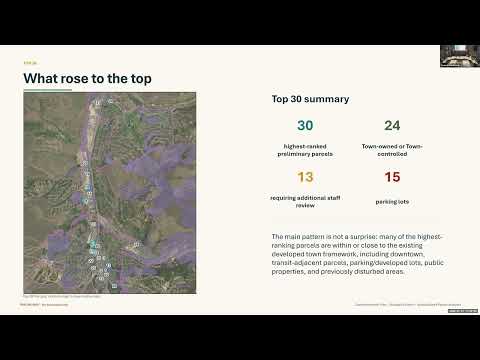
Staff presented a preliminary screening of 186 parcels using eight criteria to help the town identify infill opportunities and compare them to expansion at the urban fringe. The top 30 candidates are primarily downtown parking lots and town-owned parcels; feasibility will be assessed later.
Cliff Cross, planner 2 for the town, walked the planning commission through a preliminary parcel-screening exercise intended to inform the comprehensive plan’s strategic growth element. "The full inventory as of right now is comprised of a 186 parcels," Cross said, describing a dataset that spans parcels inside and outside town jurisdiction and is intended only to start the conversation, not to make parcel-specific commitments.
Staff explained an eight-criteria methodology—transit, ownership, zoning, parcel size, road access, utilities, development context and environmental/physical constraints—scored 1–5 and processed in ArcGIS Pro. Cross noted the top 30 candidates skew toward the downtown core and include a mix of town-owned land and parking lots: "As outlined on the right, 24 of those parcels are town owned or town controlled. 15 of the parcels are public or private parking lots," he said. Commissioners and staff emphasized that the analysis is preliminary: Cross cautioned the review “does not constitute zoning, development approval, determination of buildability, town acquisition interest, or commitment of public funding.”
Commissioners queried how privately owned lots were selected and whether the team factored development cost; staff said ownership was not heavily weighted in the first pass and that a ninth criterion—feasibility—will be added and applied in future iterations. The commission also discussed environmental constraints on specific sites, including a parcel near Wellington subject to an EPA consent decree and ongoing remediation, which staff said would require federal negotiation before development could proceed. The commission directed staff to continue refining the maps and to bring individual parcels back for more detailed review in upcoming meetings.