Get Full Government Meeting Transcripts, Videos, & Alerts Forever!
Get email alerts on the Budget topic
No spam. Unsubscribe anytime.
Chicago school leaders present $9.88 billion FY27 budget and warn of payroll risk without quick action
Summary
Acting budget staff presented a $9.88 billion FY27 proposal that narrows a $732 million starting deficit to roughly $297.6 million through structural cuts, assumed TIF revenue, five proposed furlough days and a midyear spending freeze; staff warned lenders may not finance short-term borrowing without an approved budget and that payroll could be at risk in September.
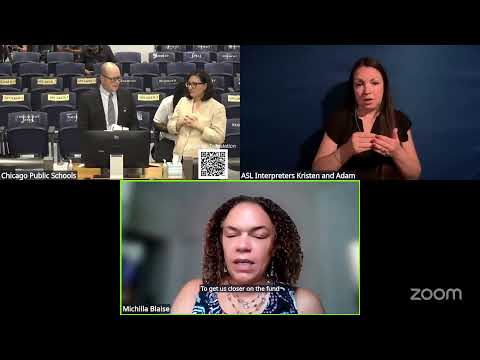
Acting Chief Budget Officer Emmy Lozoco presented the Chicago Public Schools’ proposed FY27 budget on July 20, saying the district’s total request is $9.88 billion across capital, debt and operating funds and that the spending plan reduces an initial $732 million deficit to about $297.6 million through a mix of structural savings and other measures.
Lozoco said the district identified $434.9 million in total deficit reduction, of which roughly $330 million is structural. She described school-budget changes that increase school allocations by about $143 million year over year, while projecting an overall net decline in school-based positions of roughly 164 FTEs (about 1 percent). "We reduced core teacher allocations, charter school funding, and needs-based discretionary funding due to decreasing enrollment and changes in our formulas," Lozoco said during the presentation.
Lozoco outlined three additional measures described as ‘‘last resort’’ to bring the budget into legal balance: assuming an additional $100 million in TIF surplus (for a total $200 million TIF assumption), instituting five furlough days for all CPS employees (projected to save about $85 million), and a districtwide midyear spending freeze combined with contractual savings (projected to save about $112 million). "These are measures of last resort, and they are timed on purpose ... to allow us time to continue pursuing additional revenue while protecting student instructional time," she said.
Staff also warned of urgent short-term borrowing needs. The district's current tax-anticipation note (TAN) capacity of about $1.25 billion, Lozoco said, is expected to be exhausted in August and lenders typically require an approved budget and tax levy to extend new short-term financing. "Without an approved FY27 budget this month, CPS may not have enough time to engage with lenders in order to secure funding," Lozoco said, adding that the district could face difficulty making payroll in September if borrowing authority is not authorized.
Board members pressed for clarity on the assumptions underpinning the budget. In response to a question about whether an approved budget is necessary to avoid payroll disruption, one member asked: "Am I correct that if we do not approve this budget, we're in high danger of not being able to make payroll for the staff that we do have?" Staff answered, "That's correct." Members also questioned the realism of the TIF assumptions and asked what concrete legislative actions the district plans to pursue to secure state revenue.
The district said bridge-loan discussions are ongoing with Cook County and that county distributions of property-tax revenue are running below typical historical rates (staff cited distributions close to 87 percent versus a usual ~98 percent), leaving roughly $250 million in delayed property-tax receipts. Staff said some combination of additional TIF surplus and county bridge financing would reduce pressure on midyear measures but emphasized those options have constraints and timing risks.
The Board’s next steps include a second public hearing later the same day and a planned vote on the budget and tax levy at the July 30 Board meeting; an approved budget and levy are required to pursue the short-term borrowing staff say is needed to meet early-fall payroll and vendor obligations.