Get Full Government Meeting Transcripts, Videos, & Alerts Forever!
Get email alerts on the Capital Investment Plan topic
No spam. Unsubscribe anytime.
ODOT unveils new 10‑year Capital Investment Plan approach; regions, ACTs submit candidate projects
Summary
ODOT described a new 10‑year Capital Investment Plan (CIP) process: regions and area commissions submitted candidate projects (top‑5 per ACT), projects will be scored against performance goals and harmonized by a selection committee that includes ODOT and local partners; staff will publish a draft for public outreach and aim to finalize a first CIP by year‑end.
ODOT staff presented the agency’s approach for a new 10‑year Capital Investment Plan (CIP). The CIP will replace a purely STIP‑driven pipeline with a performance‑based, statewide portfolio that prioritizes safety, preservation, multimodal options, freight and equity. Staff asked area commissions on transportation (ACTs) and regional offices to nominate candidate projects — ACTs were asked for top‑5 priorities and up to 10 additional investments of interest — and program areas (pavement, bridge, culverts) submitted candidate lists as well.
Project candidates will be scored against an objective framework tied to adopted priorities (safety, state of good repair, economic vitality, equity and multimodal service). The selection committee — co‑chaired by policy and delivery division leads and including regional and external stakeholders (MPOs, cities, counties) — will harmonize scores with cost, delivery timelines and statewide balance (urban/rural and people vs. freight). Staff emphasized the CIP is a multi‑year iterative process and will be used to present realistic funding scenarios to the legislature and other partners.
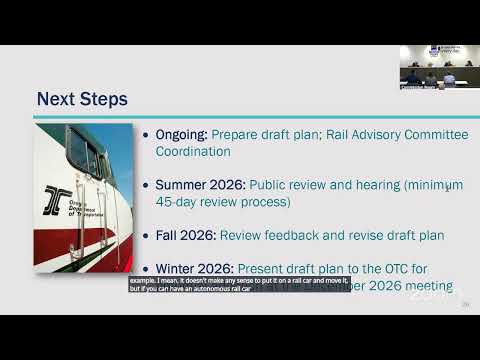
Staff committed to transparent feedback loops: ACTs will learn how their projects scored and staff will publish an appendixed list of additional investments of interest. Public outreach will follow a draft plan, and staff aim to finalize the first CIP by the end of 2026 so it can inform upcoming budget and legislative discussions.