Get Full Government Meeting Transcripts, Videos, & Alerts Forever!
Get email alerts on the Budget topic
No spam. Unsubscribe anytime.
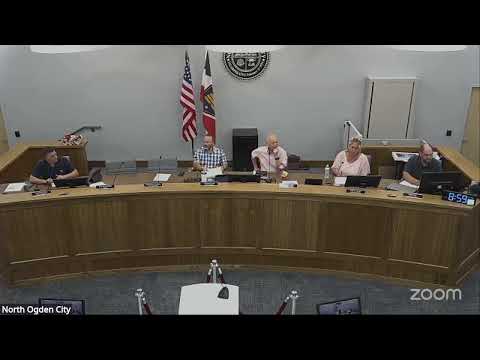
North Ogden Council pauses planned property-tax increase, adopts interim budget
Summary
After reviewing newly identified revenues and fund-balance options, the North Ogden City Council voted unanimously to adopt the 2026–27 interim budget without the proposed $150,000 property-tax increase; council directed staff to use a conservative sales-tax baseline method and to return with more detail if needed.
The North Ogden City Council voted unanimously June 16 to adopt the city's interim 2026–27 budget without moving forward on a proposed property-tax increase. Finance Director Peter Brown had presented an interim budget that included a potential 5% property-tax rate increase (an annual $19.13 on an average $535,000 residence), but council members said newly identified revenues and conservative forecasting reduced the need to increase rates.
Councilmember Dalpass, serving as mayor pro tem, opened public hearings and said the council "indicate[d] a high likelihood that we will not propose a property tax increase" while still holding the required public hearings. Brown had earlier read the property-tax example: "the North Ogden City tax on a $535,000 residence would increase from $383.70 to $402.83, which is $19.13 per year." The council instead chose to remove the $150,000 property-tax increase line from the interim budget and to modestly reduce a sales-tax projection, adopting ordinance 2026-18 by unanimous roll-call vote.
Council members who urged caution noted that some favorable revenue items are one-time or subject to volatility. Councilmember Pulver recommended using audited prior-year sales-tax actuals as a conservative baseline rather than projecting growth, arguing it reduces the chance of overestimating recurring revenue. Mayor Barker and others said staff should complete the full presentation of expenditures and funds before a final determination, and Brown agreed to provide more detailed project-level roll-forwards at the next meeting. The council asked staff to propose a policy to govern how any sales-tax overage is earmarked going forward.
The decision leaves in place the city's interim operating plan for fiscal year 2026–27 while requiring staff to track and report the revenue flows and to return with project-specific adjustments as needed.