Get Full Government Meeting Transcripts, Videos, & Alerts Forever!
Get email alerts on the Zoning Reform topic
No spam. Unsubscribe anytime.
Commission continues hearing on zoning text amendment to implement CT Public Act 25‑1 and a form‑based code
Summary
The commission reviewed draft zoning text to comply with Public Act 25‑1 (middle housing, parking reform and municipal housing growth plans) and to adopt a local form‑based code for town centers; after extensive discussion and public comment the hearing was continued to the first meeting in September for further edits and outreach to regional agencies.
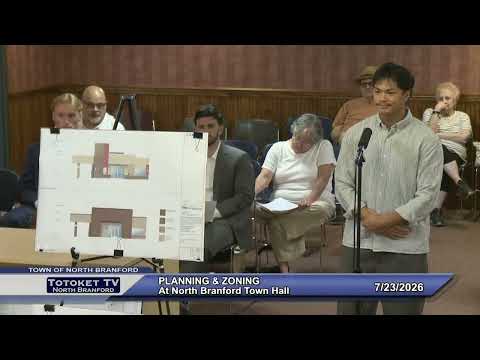
The North Brantford Planning & Zoning Commission opened a public hearing on July 23 for a text amendment (application 2026‑8) to align local regulations with Connecticut Public Act 25‑1 and to incorporate a form‑based code for town centers.
Town planner Bruce Perkins summarized the statute and the draft changes, saying in part a "transit community middle housing development is a residential building containing not less than 2 dwelling units, but not more than 9 such units." He explained the draft would allow middle‑housing and certain mixed‑use conversions in commercial zones by summary/site‑plan review while preserving local control over bulk standards, setbacks, height and design elements. The draft also addresses parking reforms, municipal housing growth plans, and potential state grants for infrastructure.
Commissioners debated specific numeric standards (front/side/rear setbacks, maximum lot coverage, facade material percentages and the number of mandatory building elements per facade). Some commissioners proposed stricter setbacks and increased material requirements (for example, changing proposed front setback ranges and reducing maximum lot coverage from 80% to 70%).
Developer and designer Eddie Lawton spoke in support of a walkable town‑center vision but cautioned some provisions (floor height/dormer spacing, a flat cap of nine units per lot, and 10‑foot sidewalk widths) could make desirable projects impractical. Town planner Perkins and commissioners agreed more outreach and additional guidance from regional planning (COGs/Scrog) and OPM would clarify implementation; the commission continued the hearing to the first meeting in September to allow edits and regional briefing.
Why it matters: Public Act 25‑1 creates new statutory obligations and incentives that change how municipalities approve certain housing types; the commission's draft is a local implementation of those statewide directives and could alter where and how multi‑unit housing and conversions happen in North Brantford.
Next steps: staff to refine language, coordinate outreach with the regional council of governments and OPM guidance, and bring revised text back to the commission at the September meeting.