Get Full Government Meeting Transcripts, Videos, & Alerts Forever!
Get email alerts on the Project Delivery Methods topic
No spam. Unsubscribe anytime.
Commission hears trade-offs among design-bid-build, CMAR and design-build
Summary
Public works staff told commissioners that design-bid-build works well for most infrastructure while CMAR and design-build are preferred for vertical projects; commissioners pressed staff on contingencies, contingency ownership, and past cost growth on the joint maintenance facility.
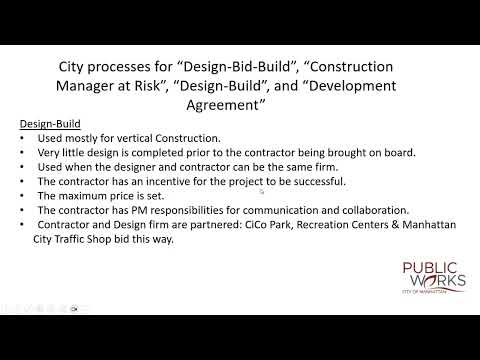
City engineers laid out the pros and cons of three common project-delivery methods. Brian Johnson said design-bid-build remains the city’s standard for infrastructure work because it separates design and construction and provides unit pricing; by contrast, construction manager at risk (CMAR) and design-build bring contractors in earlier to help control schedule and identify cost savings.
"What this does is it forces a partnership, between the design team and the construction team so that that construction team brought on board early," Johnson said, outlining how early contractor involvement can yield faster schedules and potential material savings. He added that CMAR shifts certain price risks to the contractor through a guaranteed maximum price while design-build often combines the builder and designer in one firm, improving communication.
Commissioners asked about contingencies and whether holding 5–8% owner contingencies gives contractors an escape from responsibility. Johnson replied, "That contingency is ours. We spend it if we want it. We don't. They don't spend it. It's ours to spend." Members also revisited the joint maintenance facility, where multi-year design and market escalation contributed to price growth; staff said the project had been in development for several years before bids arrived.
The presentation included practical examples of when each delivery model is most suitable and encouraged commissioners to consider the trade-offs—owner control versus schedule savings—when authorizing future projects.