Get Full Government Meeting Transcripts, Videos, & Alerts Forever!
Get email alerts on the Surveillance Cameras topic
No spam. Unsubscribe anytime.
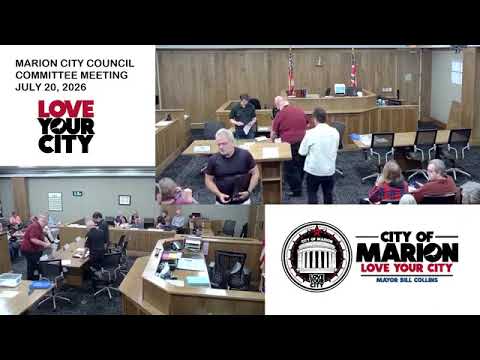
Marion committee holds first reading of ordinance to ban Flock ALPRs after hours of public comment
Summary
A proposed ordinance to prohibit Flock automatic license-plate readers in Marion drew dozens of public commenters and sustained debate over privacy, police utility, audits, and county versus city jurisdiction. The committee held the item for two weeks to allow legal review and additional information.
The Legislative & Codes committee opened the first reading of an ordinance that would ban Flock automatic license-plate reader (ALPR) systems in Marion and bar future contracts without council approval. The reading set off more than three hours of public comment and extensive council discussion.
Sponsor remarks laid out the ordinance’s core provisions: the use of Flock or similar systems would be prohibited citywide, current agreements would be terminated, and any future agreements would require city-council approval. “The use of Flock or any system with similar characteristics shall be prohibited within the city of Marion, Ohio,” the sponsor explained in committee.
Supporters of the cameras, including law enforcement and several council members, pointed to solved violent crimes and a recent missing-child recovery as evidence of public-safety benefit. One law-enforcement speaker said the system “has been used in just this city to solve homicides, kidnapping, domestic violence charges,” and that in one child abduction the cameras led to an out-of-state arrest.
Opponents, including many residents and technical experts, urged caution: they described examples of officer misuse in other jurisdictions, hacking vulnerabilities, and the potential for future capability creep (AI-based tracking and ‘hot lists’). Francis Rodriguez, who identified herself as a former dispatcher and Marion resident, said of a recent July 4 death, “We failed her… Where were these Flock cameras for us, the citizens?”
Speakers proposed narrower approaches: defining ALPRs and permitted uses in ordinance language, requiring external audits and public reporting, establishing an independent citizen-review board to examine query logs beyond the monthly summary reports, and obtaining a legal opinion on county-installed cameras and grant-funded equipment.
Given the volume of comment and outstanding jurisdictional and drafting questions, the committee decided to hold the matter for further review and to invite the county sheriff and county prosecutor to the next session in two weeks.