Get Full Government Meeting Transcripts, Videos, & Alerts Forever!
Get email alerts on the Customary Use topic
No spam. Unsubscribe anytime.
Seminar outlines Floridas customary-use test and why dry-sand rights differ from title
Summary
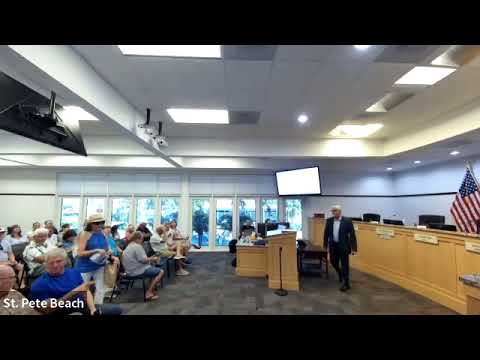
A July 23 public seminar in St. Pete Beach explained Florida's customary-use doctrine, the four-part test (ancient, reasonable, uninterrupted, free from dispute), and how courts analyze specific beach segments rather than declaring entire beaches public.
The presenter, a lecturer who said he has taught environmental and land-use law at FGCU and served as a visiting professor at the University of Florida, told attendees Floridas customary-use doctrine protects certain public recreational activities on privately titled dry sand if four judicial tests are met. He said, "Customary use is about a right of use. It's not about title or ownership of the land." (Presenter)
The talk emphasized that courts examine evidence on a beach-segment basis and that customary use is distinct from claims that arise under the public-trust doctrine for land below mean high water. The presenter listed the four prongs a party must prove: ancient, reasonable, uninterrupted, and free from dispute, and noted that courts require parcel-specific testimony and documentary evidence (photos, parking records, maintenance records) rather than general claims about an entire shoreline.