Get Full Government Meeting Transcripts, Videos, & Alerts Forever!
Get email alerts on the Land Use topic
No spam. Unsubscribe anytime.
Zoning board approves setback variance to allow townhomes at 221 West Michigan and 215 South Pine
Summary
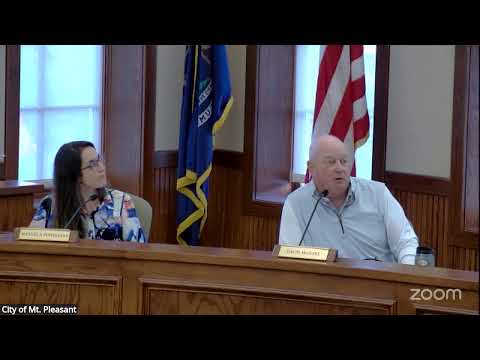
The Mount Pleasant Zoning Board of Appeals approved variance PZBA26002 to permit a reduced corner setback for a proposed townhome project spanning 221 West Michigan and 215 South Pine; staff recommended approval citing unique site constraints and consistency with the 2015 master plan.
The Mount Pleasant Zoning Board of Appeals voted to approve variance PZBA26002, allowing a reduced corner setback so a proposed townhome development can proceed at 221 West Michigan and the adjacent 215 South Pine parcels.
Planning staff presented the case and recommended approval, concluding that “staff finds the requested variance meets the applicable standards” and that the request is consistent with the city’s 2015 master plan and the goal of adding “missing middle” housing. Staff described the site as a corner lot with overlapping requirements—zero lot-line rules for City 5, a corner clearance/sight-triangle requirement, and a window sill height rule that together create constraints unique to the parcel.
The presentation included a recent minor site-plan revision: the driveway approach was shifted north to meet public-works standards, which reduced the separation between the two proposed townhomes from about 20 feet to roughly 14 feet. Staff told the board that none of the minor alterations changed the substance of the request and that they did not anticipate substantial negative impacts to adjacent properties.
Developer Neil Yalamarti, representing N18 Development LLC, said his team tried to make the project conform to existing rules but that “a confluence of 3 different things” made the variance necessary. He described the 215 parcel as blighted and underutilized and urged the board to approve a project he said would bring positive change to the site.
After brief board deliberation through the six statutory findings for dimensional variances, a committee member moved to approve the variance and the motion passed with the affirmative votes required. The board recorded the motion to approve the variance as written (PZBA26002) and voted to adopt the staff recommendation.
The board closed the case and adjourned the meeting. No implementation timeline was specified during the hearing.