Get Full Government Meeting Transcripts, Videos, & Alerts Forever!
Get email alerts on the Wetlands Development topic
No spam. Unsubscribe anytime.
Commission closes Monroe Turnpike public hearing after revised plans, will deliberate further
Summary
After a presentation by the applicant's engineer and independent testing showing historic contamination linked to a 1985 underground tank, the commission closed the Monroe Turnpike public hearing and moved to deliberations; commissioners asked staff to draft both approval and denial language and to seek input from an absent member before a final vote.
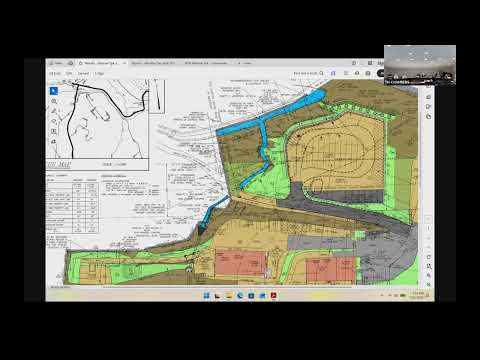
The Inland Wetland Commission closed the public hearing on a proposed excavator contractor facility on Monroe Turnpike and moved into deliberations after hearing a detailed engineering update and an environmental testing report.
Mark Johnson Jr., a professional engineer representing the applicant, described plan revisions that moved a retaining wall farther from wetlands, established an 8-foot planting bed at the wall base and committed to extensive plantings and boulders as a driveway guide. "Total is 34 trees, a 130 shrubs, and a 140 ferns," Johnson said as he summarized the mitigation plantings the applicant has proposed. Johnson also said the relocated retaining wall will be 34 to 37 feet from the nearest flagged watercourse in the revised layout.
Andrew Brotman, the commission's wetlands enforcement officer, told commissioners he had reviewed new submittals and exhibits and that Robinson Environmental Associates had performed testing of the unnamed watercourse. The consultant's report tied orange staining in the water (iron ochre) to a historical leaking underground oil tank on the Stephenson property in 1985; monitoring in 2020 and 2022 showed volatile organic compounds had attenuated to trace concentrations below applicable criteria, Brotman said.
Nearby resident William Wiley, who identified himself as living at 1609 Monroe Turnpike, thanked the applicant for some revisions and asked the applicant to provide neighbors with localized advance notice of construction activity. "All we were just asking is, basically for them to put a notice on our door... when they might be doing work, 2 days in advance," Wiley said.
After questions about distances, wall heights and lighting, Commissioner (name withheld in record) moved to close the public hearing and begin deliberations. The motion was seconded, passed by voice vote and recorded by the chair with one abstention. Several commissioners said they wanted one absent member to participate before a final decision; staff was asked to draft both approval and denial language and return the item at the next meeting for final action.
The commission also directed staff to keep the Robinson Environmental report available to state environmental officials if the body decides further expert review is needed. The public hearing record remains closed and the matter is now in internal deliberations.