Get Full Government Meeting Transcripts, Videos, & Alerts Forever!
Get email alerts on the Bpc 157 topic
No spam. Unsubscribe anytime.
FDA staff recommends against adding BPC‑157 to compounding bulks list; clinicians and patients urge regulated access
Summary
FDA reviewers told the advisory committee that BPC‑157 nominations lacked consistent chemical identification, complete certificates of analysis and robust human safety/effectiveness data; public commenters and many clinicians said regulated compounding access would reduce gray‑market harms and urged listing with safeguards.
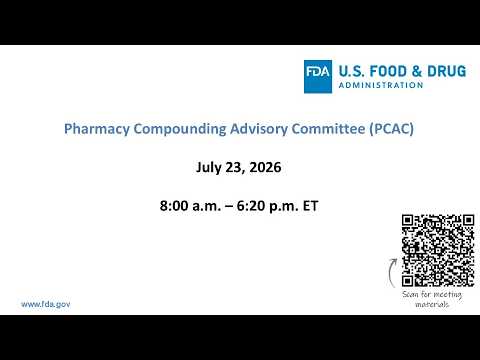
The Food and Drug Administration told the Pharmacy Compounding Advisory Committee July 23 that it recommends against placing BPC‑157 (both free base and acetate forms) on the Section 503A bulks list because the agency found inconsistent naming and incomplete characterization in the nomination packages and limited human safety and effectiveness evidence. "Our evaluators concluded that these substances are not well‑characterized from a physicochemical perspective," said Matt Lash, acting director in CDER's Office of Compounding Quality and Compliance, in an agency presentation.
At the committee's open public hearing, clinicians, patient advocates and compounding groups described widespread patient use and urged a regulated pathway. "Patients are safest when they remain inside the healthcare system," said Tina Heniger, a nurse practitioner and patient living with autoimmune disease, who asked the committee to avoid driving use into anonymous online vendors. Industry and compounding representatives acknowledged gaps in the market but argued regulated compounding would improve traceability and testing. Mike Stone, a peptide supplier, said he had worked to trace vendors to GMP‑compliant sites and called for supply‑chain certainty.
FDA reviewers highlighted specific concerns: nominators submitted certificates of analysis that sometimes referenced a different salt form than the named substance; COAs often lacked identity and impurity characterizations, aggregate testing and bacterial‑endotoxin (BET) results that are critical for injectable routes. "We cannot rule out the potential for immunogenicity, especially when these peptides are formulated for injection," said Elizabeth Hankla, clinical reviewer in the Office of New Drugs.
Public commenters disputed that listing would endorse a drug. Peter Lurie of the Center for Science in the Public Interest said adding the peptides to the bulks list would risk creating a de‑facto approval pathway without the evidence for safety and effectiveness that FDA requires. Several clinicians including those representing compounding networks said retrospective pharmacy records show low complaint rates and that absence of regulated access forces patients to the unregulated marketplace.
The committee conducted an advisory vote on BPC‑157; members split, offering a mix of recommendations and conditions. The FDA emphasized that a committee recommendation is advisory and any final decision will be reached through rulemaking after the agency reviews the full docket and public comments. The agency also told the panel it will continue to consider additional information submitted on the public docket in the post‑hearing rulemaking process.