Get Full Government Meeting Transcripts, Videos, & Alerts Forever!
Get email alerts on the Bilingual Programming topic
No spam. Unsubscribe anytime.
Consultants present vision for two-way dual-language kindergarten at Doty Elementary
Summary
Consultants and district staff presented a visioning report to establish a two-way dual language (50/50) kindergarten at Doty Elementary, citing district demographics and early results (30 students earning the seal of biliteracy across four high schools) and urging governance, recruitment and equity guardrails.
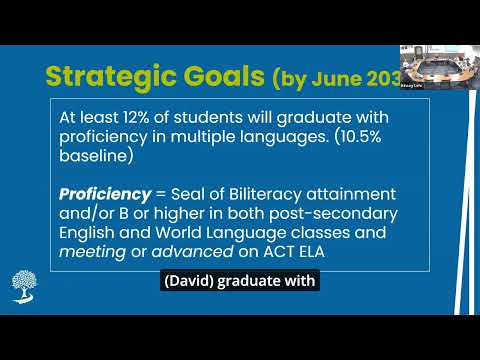
Consultants and district leaders presented a vision to launch a two-way dual language kindergarten class at Doty Elementary and described how the program aligns with the board's strategic goal of increasing multilingual graduates. "Our theme captures the heart of it, Bilingual minds, boundless potential," one presenter said, framing the initiative as a long-term pipeline rather than a single-class experiment.
Presenters said the district currently has a baseline above 10.5% toward the board's 12% multilingual-graduates target and reported that 30 students earned the state's seal of biliteracy across the district's four comprehensive high schools in 2024–25. The consultants also cited demographics: "By September 2025, Latino students made up 35.4% of the district," and they noted that roughly 40.2% of this year's kindergarten cohort is Latino, arguing the 50/50 model mirrors the population entering schools.
Board members pressed for implementation details and safeguards. Questions focused on the previous program 'cliff' where language-instruction balance narrowed in upper grades, the risk that a specialty pathway could narrow access for Spanish-dominant families, and teacher recruitment. The consultants and district staff emphasized phased growth (one kindergarten cohort as a start), recruiting teacher pairs and protected planning time, and using "explicit guardrails, continuous data review, and public accountability" to preserve equity.
District staff said the vision document is a starting point for implementation work that will come back to the board. "We are really relying on district leadership, the board, and the teachers, to work towards that next phase, which would be implementation," a consultant said. Several board members asked staff to develop governance documentation, budget implications and concrete cost proposals before launch of the classroom this fall.
The report recommended six practical priorities, including targeted recruitment and messaging, hiring and training bilingual teachers, a structural family engagement plan, and data evaluation measures so the program can be monitored and adjusted over time. The consultants and staff said the Doty–Langlade consolidation, the building expansion funded by a recent referendum, and an existing deaf/hard-of-hearing program provide an environment that can support a linguistically rich kindergarten program.
The board did not take an implementation vote during the work session; members asked for follow-up materials on staffing, governance, and the budget implications for the coming weeks as the district moves from vision to operational planning.