Get Full Government Meeting Transcripts, Videos, & Alerts Forever!
Get email alerts on the Lead Monitoring topic
No spam. Unsubscribe anytime.
Air district outlines lead-monitoring plan near Sacramento Executive Airport, touts conservative screening threshold
Summary
Staff proposed paired upwind and downwind monitors and a five-part analysis to distinguish lead from aviation gasoline versus resuspended soil; staff identified a conservative screening threshold of 0.033 µg/m3 to prompt deeper analysis and pledged to work with the airport and the Mangan Park community.
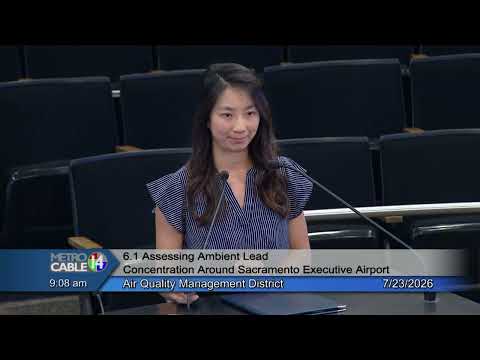
Katharine Chin Chu, an air quality scientist in the Office of Community Air Protection and Monitoring, presented the district's proposed sampling plan to assess ambient lead concentrations around Sacramento Executive Airport. Staff described placing a portable laboratory at Mangan Park and adding an upwind site so technicians can compare conditions and better separate potential aviation-gasoline signals from lead resuspended from historic shooting-range soil.
"We calculated a lead concentration of 0.033 micrograms per meter cubed," Chin Chu said, describing the district's health‑protective screening value and the analytical methods that would trigger a deeper investigation. She outlined five analytical approaches — particle-size distributions, chemical fingerprints (for example, bromine as a marker for aviation gasoline and antimony/tin for bullets), wind-threshold analysis, correlations and statistical modeling — to help attribute sources if concentrations exceed the screening level.
Directors pressed staff on how the threshold could be used in other settings. Director Serna said a locally derived yardstick could help inform CEQA health assessments without requiring expensive, project‑level risk studies in every case; Dr. Ayala and Chin Chu replied that the 0.033 µg/m3 value is intended as a conservative trigger for additional analysis and that applying it in CEQA would depend on the lead agency and the state of the science. Dr. Ayala emphasized the district's intent to be efficient: staff do not want to "chase" negligible concentrations or pursue expensive analyses when they are unlikely to be informative.
In public comment, Jennifer Holden, president of the Mangan Park Neighborhood Association, urged more monitoring for lead and PM2.5 and requested soil testing on adjacent city-owned property she identified as the former tree nursery on 34th Avenue. "This is about protecting health," Holden said, noting local respiratory‑disease indicators and concerns about children playing near the runway.
Staff asked the board for concurrence to proceed with the sampling plan and said they will coordinate timing with Sacramento Executive Airport repair and construction activity and engage a community steering committee on monitoring schedules. The board did not take a separate formal vote on the sampling plan during the meeting but asked substantive questions that staff said they would incorporate as they finalize monitoring details.