Get Full Government Meeting Transcripts, Videos, & Alerts Forever!
Get email alerts on the Land Use Subdivision topic
No spam. Unsubscribe anytime.
Planning board approves Orangeburg Road subdivision with stormwater conditions
Summary
The Borough of Old Tappan Planning Board approved a two-lot subdivision and related bulk variances for a property on Orangeburg Road, contingent on stormwater improvements, maintenance obligations and a developer's agreement. The board said the design provides regional drainage benefits to downstream properties.
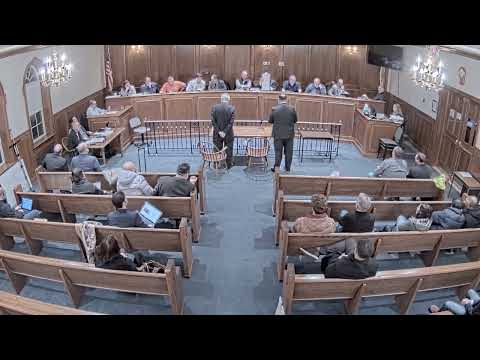
The Borough of Old Tappan Planning Board voted Feb. 12 to approve a subdivision that splits a large, existing lot on Orangeburg Road into two parcels and grants several dimensional variances, subject to a developer's agreement and recorded maintenance obligations. Chair opened the motion and the board conducted a roll call; the chair later announced, "the application's approved," and said the approval is "subject to my developer's agreement and another resolution."
Applicant counsel and retained professionals told the board the revised plan (revision date Jan. 28, 2025) includes a county-height curb along the frontage, catch basins at the driveway and a series of seepage pits and an oversized infiltration trench behind the garage to capture driveway and rooftop runoff. Engineer Martins described the improvements as intended to "direct the water, keep it on to the roadway where it belongs" and to protect downstream neighbors on Perry Street. On storage, board questioning produced a design comparison: engineers said the new system provides about 9,700 gallons of storage versus roughly 6,700 gallons of runoff for a two-inch design storm over the proposed pool, patio and driveway area, a roughly 50% margin of additional capacity.
Planner Matthew Flynn, testifying for the applicant, said the lot straddles multiple zoning districts and characterized a requested floor-area-ratio relief as "de minimis" (he noted the effective FAR would be about 0.162 versus a 0.16 requirement). Flynn argued the subdivision and the stormwater improvements produce public benefits and fit the neighborhood pattern. Board members pressed for conditions: soil-permeability testing prior to construction if required, an enforcement path for routine maintenance of catch basins and infiltration features, and a developer's agreement to run with the land so future owners inherit maintenance responsibilities. The board recorded the approval with those stipulations and set related resolution language for follow-up before the next (March) meeting.