Get Full Government Meeting Transcripts, Videos, & Alerts Forever!
Get email alerts on the Monitoring topic
No spam. Unsubscribe anytime.
APCC, town highlight monitoring gaps and cyanobacteria risk tiers
Summary
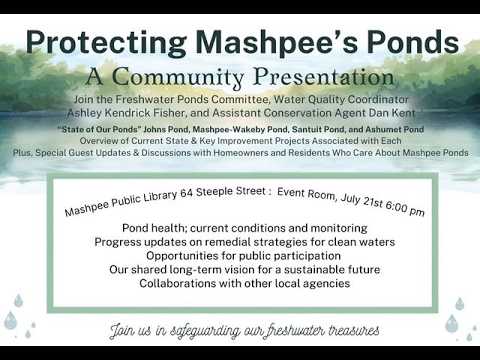
APCC and town partners said monitoring coverage is incomplete across Mashpee’s 69 freshwater ponds; APCC described its risk-tier system and toxin testing (microcystin) used to inform advisories and signage, and announced an expanded zooplankton pilot and monthly sampling program.
Julie of the Association to Preserve Cape Cod (APCC) described regional freshwater-monitoring programs and the cyanobacteria risk framework used to classify ponds as blue (acceptable), yellow (potential concern) or red (public‑health concern). She said monthly samples are collected March–November and that APCC has expanded from an initial set of 50 ponds to roughly 150 monitoring sites across Cape Cod.
"We only have toxin data paired with biomass since 2022," Julie said, explaining APCC and county partners added toxin testing (microcystin) in recent years and use a conservative ecosystem flag of 8 parts per billion microcystin in some assessments. She emphasized morning sampling to account for buoyant cyanobacteria and noted towns decide when to post signage or issue advisories.
APCC will pilot zooplankton sampling this year across about 75 ponds to understand biological community changes. Town staff and APCC stressed data gaps: only four ponds in Mashpee had consistent long‑term testing historically; the committee is pursuing diagnostic assessments to establish updated baselines for ponds such as John's Pond and the Wakeby Basin.