Get Full Government Meeting Transcripts, Videos, & Alerts Forever!
Get email alerts on the Alum Treatment topic
No spam. Unsubscribe anytime.
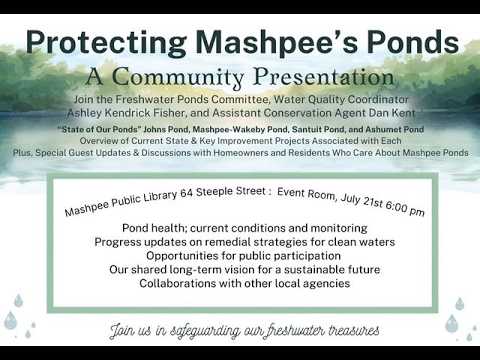
Town schedules alum treatments on Santoette Pond after multi-year studies
Summary
Town and partners plan two alum (aluminum sulfate) applications on Santoette Pond—November 2026 and November 2027—after diagnostics found most phosphorus in the pond is sediment‑bound; follow‑up monitoring and buffers, sewering and stormwater work are expected to extend treatment benefits.
The Mashpee Freshwater Ponds Committee and regional partners announced that Santoette Pond will receive two alum (aluminum sulfate) inactivation treatments to address decades of phosphorus accumulation in pond sediments. Danica Bell, liaison for the SNEP/SNAP network, said the town and its consultants have scheduled an initial application for November 2026 and a follow-up in November 2027.
"We will apply alum by boat; each treatment will take a few days and the chemicals settle within minutes to hours," Bell said, adding that liquid sodium aluminate will be co-applied as a pH buffer to mitigate short‑term acidity risks. She said recreational use will likely be restricted during application for applicator safety and to avoid disturbance of the treatment operations.
Why the town is pursuing alum: consultants and past studies found most of Santoette’s phosphorus is already stored in sediments, fueling recurrent cyanobacteria blooms. At the meeting, Ashley Fisher, the town’s water‑quality coordinator, summarized earlier work and funding that enabled the current project. "This project has years of study behind it," Fisher said, noting the watershed‑based plan developed with the Mashpee Wampanoag tribe made the project eligible for EPA nonpoint‑source (Section 319) funding.
Technical oversight and monitoring will be on‑site. Ed Eichner, principal water scientist at TMDL Solutions, said licensed applicators will conduct dosing while consultants monitor pH and other parameters in real time so work can be paused if needed. He emphasized that alum treatments "work best in ponds where more than 50% of the phosphorus is coming from sediments," and that post‑treatment monitoring is essential to measure efficiency and longevity.
The committee and project partners stressed alum is one part of a multi-pronged plan: stormwater retrofits, sewer expansions where feasible, invasive‑species control and homeowner actions (vegetated buffers, reduced fertilizer use) will all be needed to sustain long‑term improvements. Danica said a five‑page FAQ and a project web page with details and the consultant contact information will be available for residents.