Get Full Government Meeting Transcripts, Videos, & Alerts Forever!
Get email alerts on the Ems Levy topic
No spam. Unsubscribe anytime.
Hardin County residents, EMS leaders press board for clarity on levy amount, duration and distribution
Summary
At a July 22 public hearing, Hardin County residents and EMS officials urged clarity on how a proposed EMS property tax levy would be sized, how funds would be distributed, and whether it would guarantee countywide ALS coverage; the board scheduled a second hearing for Aug. 13, 2026.
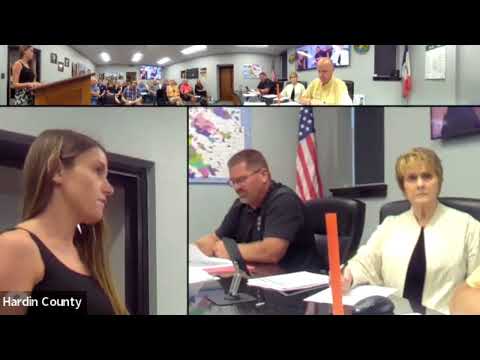
The Hardin County Board of Supervisors opened a public hearing July 22 on a proposed Emergency Medical Services property tax levy intended for the Nov. 3, 2026 general election, hearing more than an hour of public comment about levy size, duration and how funds would be distributed.
Michelle Kelly, city administrator for Eldora and a Steamboat Rock resident, said she supports giving county voters the opportunity to decide but asked the board to explain why it proposed a different funding model than the EMS advisory council: "The advisory committee proposed a dollar 50 per thousand assessed valuation for 15 years. The board of supervisors are coming forward on a ballot with a dollar for 5 years," Kelly said, and asked whether that lower ask would still meet long‑term county EMS needs.
A commissioner who introduced the hearing said the board's priority is to put a measure on the ballot that has a realistic chance of passing: "I'm not gonna stand in the way of ballot measure, but the most important part for me is to get something on the ballot that has a chance of passing," the commissioner said, noting trade‑offs among levy amount, duration and legislative changes that could affect long‑term terms.
Corey Larson, identified as the EMS director for Iowa Falls, described the county's operational reality and costs, saying a single countywide ambulance service would likely require a largely full‑time workforce and be prohibitively expensive. He estimated combined agency costs "somewhere between, probably 2 and 2,500,000" and said the county currently has roughly 10–11 ambulances available at a time. "What EMS essential would do is ... it does provide enough of a boost ... to most of our municipal services that will allow them to continue to provide the service that they are providing," Larson said.
Speakers repeatedly asked how the levy proceeds would be allocated when townships or cities do not operate an ambulance service, whether funding would follow the provider that actually responds, and whether funding recipients would be required to meet service and reporting expectations. Board members and staff explained two approaches: funds could be routed through townships and cities to local providers under service agreements, or the county could receive and allocate funds with auditing and reporting requirements; an advisory formula presented to the board would divide proceeds among ALS, BLS and first‑responder services in areas with all three levels.
The hearing included several personal accounts praising local ambulance crews and appeals to voters to back a levy to preserve rural EMS access. After public comment, the board closed the hearing and removed adoption of a final levy resolution from the day's agenda to allow further public engagement and additional review.
The board is expected to use the next hearing and follow‑up staff work to refine ballot language and distribution details so voters can see the trade‑offs among levy levels, durations and the service levels those options would provide.