Get Full Government Meeting Transcripts, Videos, & Alerts Forever!
Get email alerts on the Case Law topic
No spam. Unsubscribe anytime.
MLAC hears case-law shift on when preexisting conditions qualify as new claims
Summary
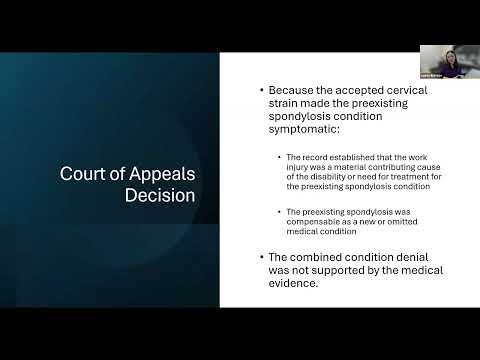
At an MLAC meeting, board staff summarized two rulings (Barnes and Amelia Negrini) clarifying that courts now require evidence the workplace injury was a major contributing cause of pathological worsening before a preexisting condition can be compensated as a standalone claim.
Lauren, a staff member providing the Workers' Compensation Board case-law update, outlined recent appellate and board decisions that narrow when a preexisting condition can be accepted as a standalone "new or omitted medical condition." She said the change follows the Barnes v. Cache Valley Electric decision and later board rulings.
"The court of appeals ... pronounced that a preexisting condition can be compensable, but only if the worker can prove that the work injury is a major contributing cause of the pathological worsening of that condition," Lauren told the committee, describing how Barnes reached that conclusion and how the board applied similar reasoning in Amelia Negrini. She explained the practical result: carriers that accept conditions as part of a combined condition may be supported by medical evidence and by the court's reasoning.
The staff update included procedural notes: a statutory change from last session (reported in the update) increased the recoverable litigation-cost award and requires parallel administrative rule changes; the board referred process-improvement ideas to an advisory committee whose report is due Dec. 10. Lauren said stakeholders including the Oregon Trial Lawyers Association and SAIF asked the board to streamline the cost-bill process while the rule is amended.
MLAC members did not take formal action on the legal interpretations during the meeting but heard that one of the cases (Barnes) is final and that Negrini remains pending at the Court of Appeals. The committee received the update for posterity and rulemaking staff said they would return with proposed rule text as needed.