Get Full Government Meeting Transcripts, Videos, & Alerts Forever!
Get email alerts on the Density topic
No spam. Unsubscribe anytime.
Consultants tell Bandon minimum-lot sizes and density limits are key barriers to affordability
Summary
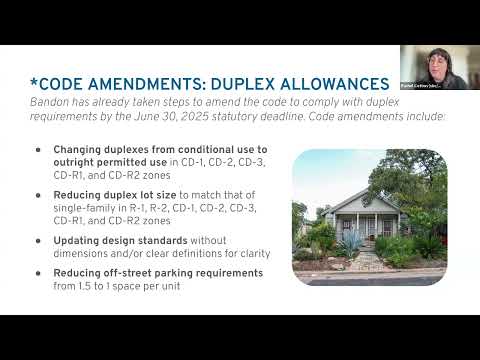
Cascadia Partners highlighted minimum lot-size requirements (examples cited: 5,400 sq ft for one unit; 9,000 sq ft to add a second unit in some zones) and maximum density and parking rules as constraints that keep smaller, more affordable housing from being feasible in Bandon.
Consultants told the joint session that minimum lot-size rules and restrictive density limits are practical barriers to producing middle‑housing types that could be more affordable. They explained how spreading the fixed cost of land and infrastructure across more units can improve project economics and potentially lower per-unit prices.
"For example, in certain zones, the requirement, if you build one unit, is 5,400 square feet of land. If you want to build an additional unit, 9,000 square feet," Rachel Cotton said, noting those minimums make many middle‑housing forms infeasible in a coastal market with high land costs. Jamin Kimmel added that increasing maximum density or reducing minimum lot sizes gives developers more feasible options to build smaller units that can be priced more affordably.
Why it matters: The consultants argued that allowing more density and revising minimum-lot requirements are among the most impactful local code changes to expand housing options in a constrained coastal market. Commissioners and staff discussed tradeoffs between neighborhood character and housing supply.
Next steps: Cascadia will propose code concepts that explore where and how increased density and revised lot-size standards could be permitted while offering design options to maintain neighborhood compatibility.