Get Full Government Meeting Transcripts, Videos, & Alerts Forever!
Get email alerts on the Budget topic
No spam. Unsubscribe anytime.
Oak Harbor School District lays out levy renewal for Feb. 11; board proposes staying at $2.28
Summary
District leaders presented a Feb. 11 renewal levy to fund programs including safety, technology, academic supports and extracurriculars; the district reported funding sources of roughly 74% state, 14% federal and 12% levy and said it will seek to remain at $2.28 per $1,000 assessed value while the statutory cap is $2.50.
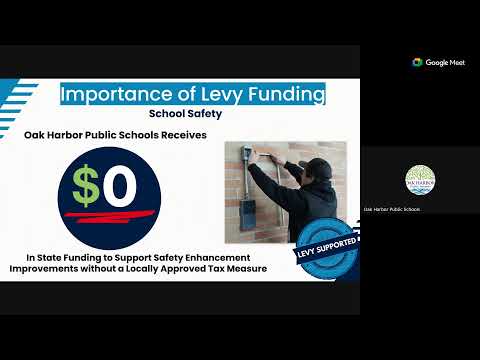
District staff presented a high-level overview of a renewal levy that will appear on the Feb. 11 ballot. The presenter described the levy as intended “to replace and maintain our existing programs,” and emphasized four community priorities: system alignment, safety, technology and academic excellence.
The presenter gave a funding breakdown during the meeting: "We receive about 74% from the state... we also receive 14% from federal funding... which doesn't make up the cost of doing business here in Oak Harbor, which is our levy funding of about 12%." She said the district intends to remain at a levy rate of $2.28 per $1,000 of assessed value; the stated statutory cap is $2.50. The presenter framed the levy as distinct from a bond, saying "A bond is for building. A levy is for learning." The board heard the presentation and asked clarifying questions; no formal vote to place the levy on the ballot was recorded during the segment covered in the transcript.
District leaders also referenced the McCleary funding adjustments and past one-time monies that affected the levy cap and local revenue calculations. The presentation emphasized maintaining current services, not expanding them, while balancing community affordability.