Get Full Government Meeting Transcripts, Videos, & Alerts Forever!
Get email alerts on the Housing Short Term Rentals topic
No spam. Unsubscribe anytime.
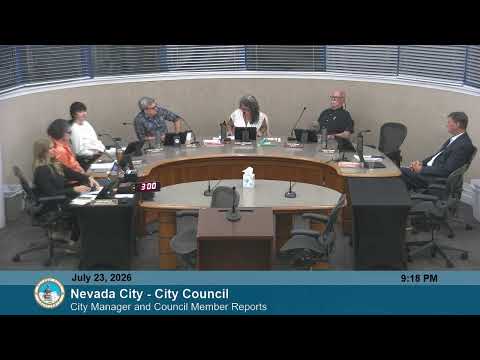
Nevada City council sends revised short‑term rental ordinance to November ballot
Summary
After months of community input, the council voted unanimously to place a revised short‑term rental ordinance on the Nov. 3 special election ballot and authorized named council members to file argument and rebuttal statements on behalf of the council.
The Nevada City Council voted unanimously July 23 to call a special municipal election on Nov. 3, 2026, to let voters decide whether to replace the city's current short‑term rental (STR) rules with a new permitting system that would create separate "hosted" and "whole‑home" permits, establish a citywide cap on whole‑home permits and set new operating and enforcement standards.
Planning Director Jessica Hankins told the council the draft ordinance would allow hosted permits without a citywide cap and limit whole‑home primary units to 2% of the existing housing inventory and ADU whole‑home permits to 1%, with new permits issued only as capacity becomes available. The proposal would require a local contact within 15 miles, add a 300‑foot separation requirement for new whole‑home rentals, require posted operational standards at the front door, and add inspection and permit‑suspension authority for repeated violations. "Because the current ordinance was initiated by voters, any changes have to be approved by voters, which is why this is a resolution to bring this to ballot," Hankins said.
Public comment filled much of the meeting. Residents described noise, parties, parking conflicts and the loss of long‑term housing after whole‑home units became frequent rentals. "Whole house short‑term rentals represent a commercial activity requiring a valid business license to operate in Nevada City and they should be separated from our residential neighborhoods," one speaker said. Other residents and part‑time homeowners urged the council to include a pathway for established homeowners who rely on intermittent rental income, saying a straight cap could push owner‑occupied homes out of service. The council acknowledged both sets of concerns during discussion.
Mayor Fernandez and Councilmember Klein framed the ballot measure as a choice between maintaining the status quo'with unlimited whole‑home rentals and limited enforcement'or adopting what staff calls a more administrable permitting system with enforcement tools. Fernandez said the proposed permit cap and new compliance software should reduce the number of noncompliant whole‑home rentals. "We estimate about 20 whole house rentals are operating without permits," Fernandez said; under the draft cap and stronger enforcement, she said, that number should decline.
Council action: the council adopted a resolution calling the special election and separately authorized specified council members to file the official argument and rebuttal for the ballot measure. Roll call votes recorded by the deputy clerk show the four members present voted yes; one member was absent. The resolution also directs the city manager or designee to take necessary actions to place the item on the ballot and to pursue associated administrative steps.
What comes next: If the measure is placed on the Nov. 3 ballot, voters will decide whether to replace the 2015 voter‑initiated ordinance with the new permitting regime. Staff told council the city will continue outreach, and the software vendor Rentalscape is expected to be operational within roughly two months to assist enforcement and permit tracking.
Votes and formal actions at a glance: the council voted to (1) adopt a resolution calling a special municipal election on Nov. 3, 2026, to submit the proposed STR ordinance to voters (unanimous among members present) and (2) authorize named council members to file an argument and rebuttal on behalf of the council (unanimous among members present).