Get email alerts on the Procedural Decision topic
No spam. Unsubscribe anytime.
Enid enforcement board denies Midcontinent's continuance request; hearing proceeds
Summary
The Enid Environmental Enforcement Board voted 5-0 on June 22 to deny Midcontinent Packaging's request to continue the enforcement hearing over a May 2025 wastewater plant upset, rejecting arguments that an arbitration conflict and outstanding records justified delay. The board then proceeded to hear opening statements and the city's case.
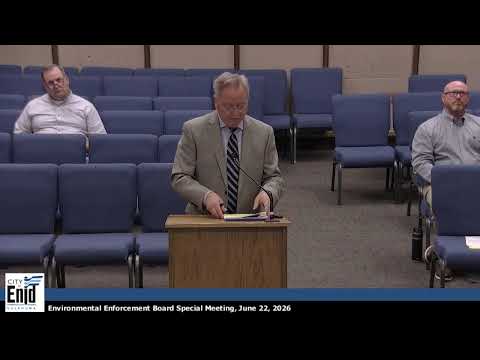
The Enid Environmental Enforcement Board voted unanimously June 22 to deny Midcontinent Packaging's motion to continue the enforcement hearing related to a May 2025 wastewater plant upset. Mark Walker, counsel for Midcontinent, told the board the company's lead attorney had a scheduling conflict and that the company still awaited documents requested under the Open Records Act. "We have four notebooks of exhibits in this case," Walker said, asking for a short continuance so lead counsel could participate.
City counsel Kaylee Davis Maddy argued the company had ample time and that an Open Records request is not a substitute for discovery in this quasi-judicial proceeding. She said the city and witnesses had relied on dates Midcontinent proposed and that the board had set the hearing after months of notice. The board then moved into an executive session as allowed by Oklahoma statute for deliberations and returned to vote 5-0 to deny the motion. Following the ruling, the board proceeded with opening statements and the city's case in chief.
Why it matters: Denying the continuance kept the June hearing schedule intact and allowed the board to hear contested technical evidence and live testimony about the cause of the plant upset, including whether quaternary ammonium compounds (QACs) from Midcontinent entered the sewer system and contributed to the nitrification failure and a fish kill reported in Skeleton Creek. The vote does not determine liability; it simply advanced the hearing to consider the evidence and legal arguments.
What happens next: The board will continue taking testimony and exhibits in the enforcement proceeding; the city seeks orders finding Midcontinent violated its industrial wastewater permit and confirmation of administrative orders requiring corrective actions and cost recovery.
AI generated
The text on this page is AI generated. Summaries, highlights, analysis, and video transcripts are all produced from the original source material.
AI can make mistakes, so if you spot one, and we will fix it for everyone.
Note: the source content is unaltered by us. Any content source we link to, be it a video, an audio recording, or a document, is presented exactly as its publisher released it. That publisher is usually a government body, sometimes an individual official or another organisation.