Get Full Government Meeting Transcripts, Videos, & Alerts Forever!
Get email alerts on the Rulemaking topic
No spam. Unsubscribe anytime.
THECB adopts rule changes on off-campus education, mental-health pipeline and community-college finance methodology
Summary
The board adopted consolidated off-campus education rules, new mental health pipeline rules, a de minimis gift rule tied to foreign-source restrictions, and multiple community college finance rule amendments (including weight adjustments and a 2-year averaging change) at the July 22 meeting.
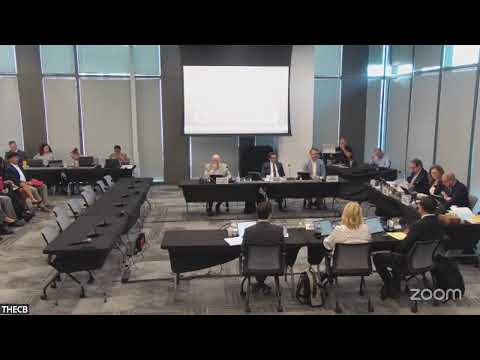
At its July 22 meeting the Texas Higher Education Coordinating Board adopted a package of rule changes affecting off-campus education, workforce pipelines and community-college finance methodology.
Staff presented consolidated amendments to chapter 2 (subchapter P) and new chapter 11C provisions to streamline approval and notification for off-campus programs and to clarify employer-requested program exemptions. Emma Gelsinger explained that the revisions harmonize approval processes across institutional types and clarified that employer-requested off-campus programs are exempt from prior location approval but still require program approval as appropriate.
The board also adopted new rules to implement the Texas Mental Health Professional Pipeline (per SB 1401) and a de minimis gift rule under HB 127 that sets a $50 noncash threshold for unsolicited items not requiring reporting, after consultation with the Higher Education Research Security Council.
On community college finance, staff described five substantive FY2027 changes, including a limit on duplicate credential types over five years, reductions in weights for some student categories (e.g., economically and academically disadvantaged weights from 25% to 20% and adult learners from 50% to 40%), removal of third-party credentials as fundable, and a shift from a three-year average to a two-year average for funding calculations. The board adopted the proposed amendments following discussion and earlier public comments opposing weight reductions.
Several items are effective Sept. 1 or upon publication as specified in the administrative packet; staff will work with institutions on implementation guidance.