Get Full Government Meeting Transcripts, Videos, & Alerts Forever!
Get email alerts on the Performance Funding topic
No spam. Unsubscribe anytime.
THECB adopts executive committee's performance-based funding recommendations for universities
Summary
The Texas Higher Education Coordinating Board on July 22 approved an executive committee's performance-based funding report recommending a formula that weights attainment at about 60%, adds progression/persistence measures, and offers transition options for institutional enhancement funding.
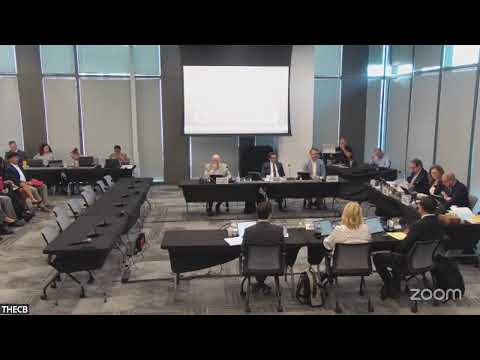
The Texas Higher Education Coordinating Board approved the executive committee's report on a new performance-based funding model for general academic institutions during its July 22 quarterly meeting.
Deputy Commissioner Sarah Keaton and members of the chancellor-appointed executive committee presented a year-long study and consensus recommendations that place degree attainment at the center of a rate-based funding approach. Keaton summarized the proposal as a model that would make attainment the primary driver of funding (about 60% of the formula) while also recognizing persistence and progression metrics, regional high-demand fields, transfer completion, and efficiency incentives.
"Attainment is a primary driver of the model, and collectively we recommend that it should drive about 60% of the funding through the model," said Lori Bettany of the executive committee during the presentation. John Wiebe of UTEP added that progression and persistence must be sufficiently weighted to reflect short-term milestones that support completion.
Board members asked detailed questions about high-demand fields, cost sensitivity, and transition strategies for institutional enhancement funding. Daniel Harper of the executive committee described an interactive model the legislature could use to manage a phased transition away from nonformula institutional enhancement funding, including options such as institutional buy-ins, caps, and minimum base funding for certain institutions.
Several public witnesses spoke during the item. Yvonne Nunez, chief of staff to Rep. Vincent Perez, testified on behalf of three House members and urged the board not to reduce weights for economically disadvantaged, academically disadvantaged, and adult learners, calling those weights "a founding tenet of the model." Student and stakeholder witnesses urged stronger measures to support transfer students and to prioritize completion.
After discussion the board moved, seconded, and approved the report and delegated authority to the commissioner to provide additional information as needed. Chair Stacy Hock called the voice vote and the motion passed.
The board's action moves the executive committee's recommendations into the agency's deliberations with the legislature; staff said the new formula concepts would be available for legislative appropriation scenarios and further refinement in future sessions.