Get Full Government Meeting Transcripts, Videos, & Alerts Forever!
Get email alerts on the Downtown Economy topic
No spam. Unsubscribe anytime.
Downtown Manhattan Inc. tells commission downtown generates about 10% of citywide sales; asks for help on curbs, lighting and Frost Plaza
Summary
Gina Snyder, executive director of Downtown Manhattan Inc., told the commission the downtown district produced roughly 10% of Manhattan’s citywide sales, reported high occupancy and event metrics, and asked the city for help funding sidewalk and lighting upgrades, programming Frost Plaza and beginning a long-term parking conversation.
Gina Snyder, introduced as the executive director of Downtown Manhattan Inc., told the Manhattan City Commission at a work session that the organization supports a broad downtown area and said its work helps generate sales tax revenue for the city. “Last year in 2025, Downtown Manhattan was responsible for 10% of the total sales in the city of Manhattan,” Snyder said, framing the district’s economic contribution as justification for ongoing public support.
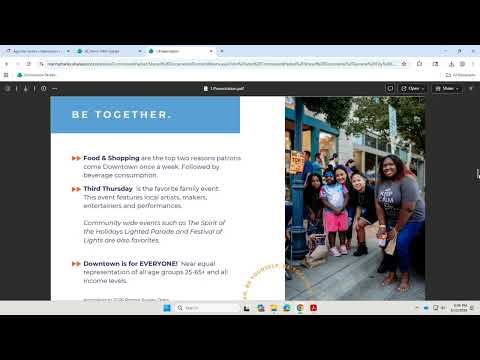
Snyder summarized the organization’s structure and reach: a volunteer board, five staff, three ex officio members, a new 501(c)(3) to pursue grants, a corporate partner program and roughly 27 events annually that drew 21,000 unique visitors during 2025. She told commissioners the district includes roughly 338 businesses and more than 3,000 employees who work and eat downtown, and she highlighted a 95% or higher BID collection rate over five years as evidence of stable funding. Snyder asked the commission to help fund aging curbs and sidewalks, replace obsolete holiday lighting that can no longer be matched, and provide resources to make Frost Plaza programmable (electrical upgrades and other work). She also said the organization would support initiating a public parking conversation and noted the MPO is conducting a parking study.
Commissioners asked routine clarifying questions about occupancy and the new 501(c)(3). In response, Snyder said commercial occupancy is about 97% and residential occupancy about 98%, and described the downtown partner program and a new retail committee created to help small retailers with succession planning and signature events. No formal action was taken; staff and DMI agreed to follow up on specific funding options and coordination steps.