Get Full Government Meeting Transcripts, Videos, & Alerts Forever!
Get email alerts on the Roads Pilot topic
No spam. Unsubscribe anytime.
ODF outlines roads pilot to test how written plans and field checks assess crossing and road rules
Summary
Monitoring staff described a two-part pilot that will review written plans for new/reconstructed water crossings and roads, add field measurements for Type F water crossings, and draw a random sample (target 60 sites) stratified east/west to test feasible compliance methods.
The Forestry Department's compliance monitoring team detailed a roads pilot study that splits work into two strands: written plan review for new and reconstructed water crossings and roads, and a field-measurement component for certain water crossings.
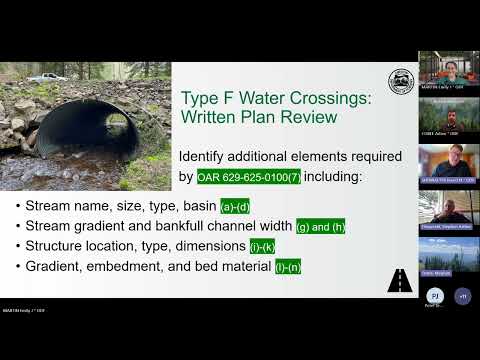
"This pilot study begins a collaborative iterative process to understand compliance with all rules, particularly the design and outcome based rules," monitoring specialist David Showalter said, summing up the team's approach to balancing checklist elements and more qualitative site understanding. He told the committee the written-plan review will identify required elements such as objectives, potentially impacted resources and watershed- and site-scale risk factors, while Type F crossings will require additional fields including stream name, bankfull channel width and bed material descriptions.
David described the sample-draw approach for the pilot: staff filtered 2025 completion notifications for relevant activity types, stratified east and west, randomly ordered candidate sites and then confirmed suitability. "Our target was 60 sites, that were allocated proportionally by the number of notifications per region and then divided evenly among the stream types," he said. The team will confirm permanency, absence of alternative practice plans and that the activity is not a land-conversion type before selecting a site.
Committee members pressed staff on how the written-plan review differs from a design evaluation. Megan expressed concern that the review could become a "yes/no checkbox" and requested the final protocols; David agreed to circulate the study protocols to the group and said the plan review is primarily checking for presence of required elements, with field observations and measurements used to characterize site conditions where appropriate.
The presentation listed several rule citations staff will use to define review elements. The pilot is intended to clarify what metrics are feasible for consistent compliance determination and what items may require an effectiveness or adaptive-management approach rather than a binary compliance flag.
Next steps: the team will complete site selection, begin landowner outreach this summer through stewardship foresters where preferred, and start in-house field data collection in the fall, with sampling results and observations to inform a fuller study design.