Get Full Government Meeting Transcripts, Videos, & Alerts Forever!
Get email alerts on the Aes Franchise topic
No spam. Unsubscribe anytime.
Piqua debate over AES franchise intensifies as second reading proceeds
Summary
At the ordinance's second reading, city counsel and AES representatives outlined franchise terms allowing AES Ohio to construct transmission facilities to serve a proposed hyperscale data center; many residents urged the commission to slow the process, raise protections and quantify foregone municipal revenue and long‑term rate impacts.
Council conducted the second reading of an ordinance that would grant AES Ohio a limited 40‑year franchise to construct and operate transmission facilities to serve a hyperscale data‑center customer on land within Piqua. City and outside counsel said the agreement narrows AES’s rights to that specific parcel and operational load, requires the project to pay transmission costs and commits AES to relocating an existing 69 kV line — a move staff estimated would cost more than $1 million if the city had to perform it.
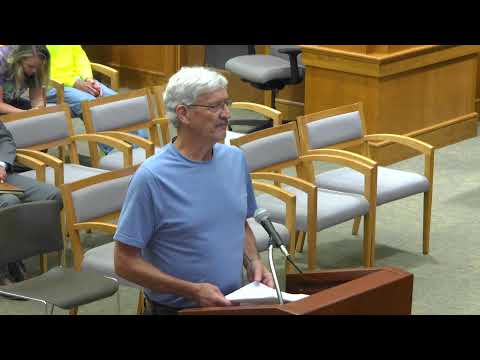
Outside counsel Matt Pritchard and city staff emphasized protections inserted into the draft ordinance, including a penalty for AES if it seeks to serve other customers and a charter‑compliance clause excluding franchise value from future acquisition price. AES representative Rob Bealer stressed that a project of the scale discussed requires interconnection to the interstate transmission grid and that transmission build‑out would involve dozens of miles and hundreds of millions of dollars of high‑voltage infrastructure; he said such investment is recovered through regulated returns. Opponents pressed for more concrete accounting: "If the city were to supply this power and charge the data center developer the exact rate that you guys already passed ... that's for 1 month just over $3,000,000," said resident Jonathan Wessel as he walked commissioners through a demand‑charge calculation and warned the city could forgo large long‑term revenue. After extended testimony and Q&A the item stood as a second reading for future consideration.