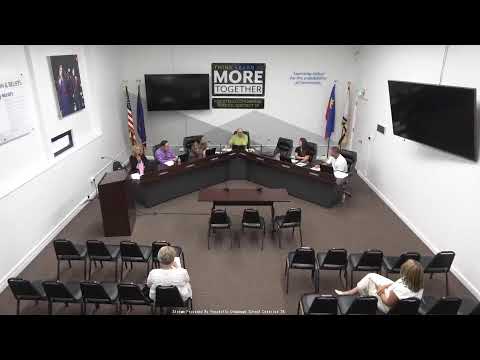
Board hears proposal for Spanish dual-immersion K–5 program with five-year rollout
Summary
Administrators presented a proposal to start a Spanish dual language immersion program with K–1 cohorts that would grow by 50 students per year to a K–5 program of about 300 learners and an estimated full operating cost of roughly $1,152,000 annually; trustees discussed locations, staffing and boundary changes.
AJ Watson, the district staff lead on program planning, presented a K–5 Spanish dual language immersion proposal the board received for information. Watson said the model would begin with kindergarten and first grade cohorts, add a cohort each year (about 50 students per cohort) and eventually expand into middle and high school depending on staffing and participation. "Each year a new cohort would be added," Watson said, and staff projected the five-year K–5 program would require about 12 certified teachers and serve roughly 300 learners.
Watson also presented a budget estimate and site options. For a full K–5 program, staff listed a projected annual operating cost of approximately $1,152,000 and noted one-time teacher training of about $3,000–$5,000 per certified staff. Trustees pressed staff on logistics: whether to house the program in a single elementary building or blend it into an existing school (Wilcox Elementary was discussed as a blended option), how boundaries would be redrawn as cohorts grow, and how the program’s lottery and admissions would work. Watson said the program would be open to all children within district boundaries and use an application and lottery process similar to the district’s Montessori program. "All students in the Pocatello [Chubbuck] School District boundary would be eligible to apply," he said.
Board members noted staffing and budget timing concerns given current enrollment declines. One trustee observed the full $1.15 million figure is for a fully implemented program and that initial-year costs would be lower if the district started with kindergarten only. The superintendent advised staff will need to factor facility capacity and possible staff reductions into decisions, and that boundary changes would likely be required if the board directs the program to move forward. Next steps noted by staff included further analysis of funding options, staffing feasibility and a decision timeline if the board wants implementation in the coming year.
AI generated
The text on this page is AI generated. Summaries, highlights, analysis, and video transcripts are all produced from the original source material.
AI can make mistakes, so if you spot one, and we will fix it for everyone.
Note: the source content is unaltered by us. Any content source we link to, be it a video, an audio recording, or a document, is presented exactly as its publisher released it. That publisher is usually a government body, sometimes an individual official or another organisation.