Get Full Government Meeting Transcripts, Videos, & Alerts Forever!
Get email alerts on the Transportation System Plan topic
No spam. Unsubscribe anytime.
Ashland planning commission begins two-year update to city transportation plan, with ODOT-funded consultant on board
Summary
Commissioners heard an informational briefing on a two-year Transportation System Plan update funded by ODOT and led by Alta Planning and Design; the plan will cover multimodal networks, tie to the comprehensive plan, and launch public engagement this fall.
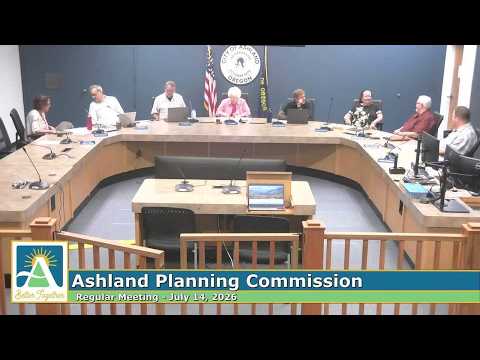
The Ashland Planning Commission on July 14 began the formal study phase of a two-year update to the city's Transportation System Plan (TSP), a 20-year multimodal blueprint that guides future street, sidewalk, bike, transit and freight investments and carries legal weight as a supporting element of the comprehensive plan. "The TSP is a long range blueprint for how people and goods will move throughout the city, over a 20 year horizon," staff member Brandon told the commission.
ODOT is providing funding and project management support for the update, and Alta Planning and Design is the lead consultant; Fair & Piers (traffic subconsultant) will handle traffic counts and future-condition modeling. Scott Fleury, Ashland's public works director and the city's project manager on the effort, said the traffic subconsultant will also evaluate emergency evacuation egress as part of the modeling. "Fair and Piers will be doing all of the traffic analysis, the traffic counts, and the future condition modeling," Fleury said.
Staff described a kickoff meeting on June 29 and a phased schedule: project start-up and a public engagement plan refinement this summer, community engagement beginning in fall 2026, inventory and future-conditions analysis in late 2026 into 2027, and solution development with preferred and cost-constrained project lists in mid- to late 2027. The commission was reminded it has two roles in the process: (1) as the city's designated committee on citizen involvement to help shape public engagement, and (2) in its legislative role to hold hearings and forward formal recommendations to council.
Brandon noted the update will incorporate recent state requirements, such as the Transportation Planning Rule provisions and measures tied to the Climate Friendly and Equitable Communities program. The TSP also ties to Ashland's 2023 buildable lands inventory and is intended to shape land-use decisions and eligibility for state and federal transportation dollars.
The commission asked about how specific topics such as parking and historic-district impacts will be handled; staff said the TSP scope will consider parking through street cross-section recommendations and performance measures, and that Historic Preservation Committee input could be added if proposed changes affect designated districts. Public engagement methods will include a project website, surveys and coordination with the city's advisory committees. The city expects the broader public input phase to begin this fall.
The meeting was informational; no action was requested or taken on the TSP at this session. The commission was encouraged to flag opportunities to enhance outreach and to anticipate future hearing dates as draft materials are developed.