Get Full Government Meeting Transcripts, Videos, & Alerts Forever!
Get email alerts on the Land Use topic
No spam. Unsubscribe anytime.
Regional planner outlines how Act 1 81 will change land-use mapping and what it means for Jamaica
Summary
Chris Davenley of the regional commission explained that Act 1 81 standardizes future-land-use categories into a statewide map, clarified that tiering and the road/driveway rule are separate processes, and urged Jamaica to submit comments before the rulemaking comment deadline (April 30).
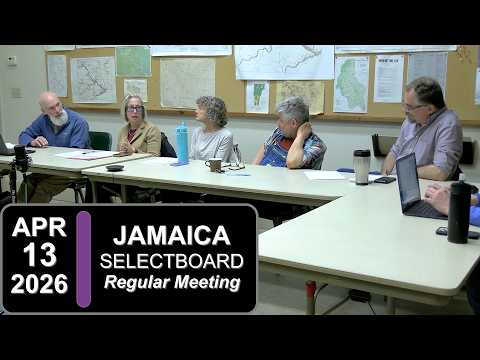
The Jamaica Select Board heard a presentation from Chris Davenley, who identified himself as executive director of the Winter Regional Commission, on the implications of Act 1 81 for regional and town planning. Davenley told the board the act standardizes future-land-use categories so regional maps can be "stitched together" statewide and said the regional plan remains advisory while providing policy guidance and grant eligibility for villages that are designated as village centers.
Davenley emphasized that the regional future-land-use map does not control tier 3 designations or the road/driveway rule. "Tier 3 in the road rule have nothing to do with the regional plan," he said, adding that tier 3 mapping and the road rule are handled by the Land Use Review Board. He explained towns can opt into tier 1a or 1b status where applicable, but that Jamaica currently lacks zoning and subdivision regulations necessary to qualify for tier 1b without statutory change.
The presenter walked the board through the standardized categories (village center, planned growth, rural general, rural agricultural and forestry, rural conservation, enterprise, and resource-based recreation) and compared Jamaica's new regional map to the town's prior plan, saying for Jamaica the differences were modest. He noted state housing targets were assigned to regions and disaggregated to towns: the Winter region's 2030 lower/upper targets are 2,571/3,730 units, while Jamaica's proposed allocation was 39 to 56 by 2030.
Board members asked procedural questions about appeals and the role of the LERB, and raised concern about practical impacts on private landowners and permit timelines. A resident and civil engineer reminded the board the public comment period on rulemaking closes April 30 and urged coordinated town comments. The board agreed to circulate suggested talking points and materials to help residents and the select board file comments before the deadline.
Next steps: board members and residents were encouraged to submit specific, targeted comments to the rulemaking process and to consider whether to seek regional approval for the town plan to protect eligibility for some municipal planning grants.