Get Full Government Meeting Transcripts, Videos, & Alerts Forever!
Get email alerts on the Program Model topic
No spam. Unsubscribe anytime.
Officials, staff discuss special-education mix and transportation as Bucks Hill plan advances
Summary
Staff said most current Bucks Hill students have special needs and described a program model with co-taught and specialized rooms; officials noted a centralized new site would reduce long transit times for many families.
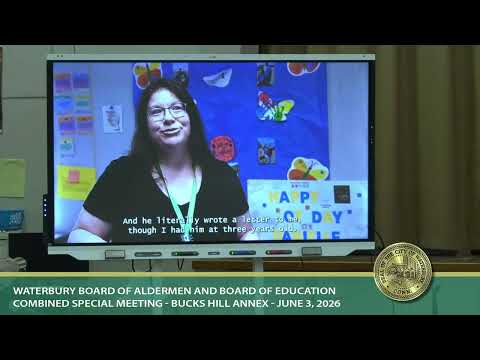
During the site tour and Q&A, staff described the educational model the district envisions for a permanent Bucks Hill preschool and discussed transportation implications for families.
A staff member said roughly 90% of students who attend the Bucks Hill program have special needs; the school mixes co-taught classrooms (regular education paired with special education) and dedicated specialized rooms for higher-support students. The staff described how students sometimes move between classroom types as their development progresses and said the proposed center would include both co-taught classrooms and specialized rooms to create a continuum of services.
Alderman Martinez McCarthy asked whether students would be displaced during construction. Swartz replied that the application does not require the district to fix the replacement building’s precise location before applying and that, if the new building were located off the current portable site, the district expects it could continue using current facilities while the new school is built. Swartz said a more centralized site would shorten travel times for many families; he gave an example that a trip from the East End took about 35 minutes, illustrating why centralization matters for students who ride buses.
Staff also outlined age-range rules: children may enter preschool at 2 years, 9 months and the district follows placement rules up to kindergarten transition (ages 5–6 depending on legal requirements and individualized education plans). The boards heard that demand for full-day programs exists but that space constraints have limited offerings.
Officials did not vote on site selection or program changes at the meeting; they heard programmatic details and asked clarifying questions.