Get Full Government Meeting Transcripts, Videos, & Alerts Forever!
Get email alerts on the Skybridge topic
No spam. Unsubscribe anytime.
STEPS committee recommends approval of Skyline pedestrian skybridge over 8th Avenue
Summary
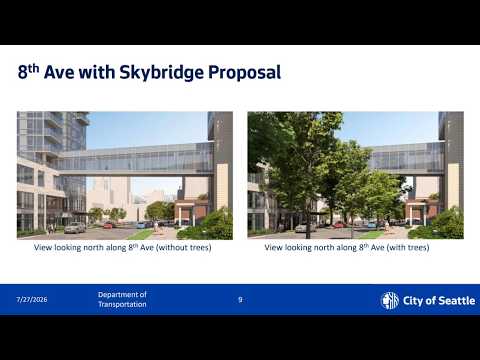
The Seattle STEPS committee voted 5-0 to recommend approval of Council Bill 121242, a 15‑year renewable permit for a pedestrian skybridge connecting two residential towers in First Hill, citing health and safety benefits and a package of community public benefits.
The Safety Transportation Engineering Project Sports and Experiences (STEPS) Committee voted unanimously to recommend approval of Council Bill 121242, an ordinance that would grant FH LLC (doing business as Skyline) permission to construct, maintain and operate a pedestrian skybridge spanning 8th Avenue between Columbia and Cherry Streets in First Hill.
Chair Rob Sacca said the ordinance stage sets the specific obligations developers must meet in exchange for use of public right-of-way and urged members to focus on whether the proposed public benefits are adequate. Amy Gray of the Seattle Department of Transportation told the committee the bridge would connect 725 9th Avenue (Cascade Tower) and 715 8th Avenue (Olympic Tower), provide an above‑grade connection for residents and visitors, and be authorized by a 15‑year permit with a renewable 15‑year term. “Skybridges take pedestrians off the street and have a visual impact on the pedestrian realm,” Gray said, adding that developers must deliver ongoing public benefits to offset those impacts.
Mark Brands, the applicant’s landscape architect, described four public benefits negotiated with SDOT and community groups: a pocket open space and landscape improvements, a public art commission with local sculptor Georgia Gerber, pedestrian safety improvements at the wide intersection of 8th and Marion (curb extensions to shorten crossings), and a new wayfinding signage package tied to the Park‑to‑Park loop.
Council Member Kettle, who said part of the project sits in his district, emphasized the bridge’s value to older residents and health‑care users who cross between medical and residential buildings. “This bridge is very important beyond connecting buildings — it’s about pedestrian safety and access to care,” Kettle said. Vice Chair Rink similarly described constituent mobility challenges and said he would vote yes.
Chair Sacca moved the committee recommendation to approve Council Bill 121242; the motion was seconded and approved on a 5‑0 roll call (votes recorded in favor: Foster, Kettle, Lynn, Rink, Sacca). The committee’s recommendation will be transmitted to the full City Council for consideration on Aug. 4, 2026. No amendments were adopted at the committee level.
What happens next: the ordinance and its permit conditions will be taken up by the full City Council on Aug. 4. If the council approves the ordinance, the permit and the public‑benefit commitments will bind the developer for the permit term.