Get Full Government Meeting Transcripts, Videos, & Alerts Forever!
Get email alerts on the Dispatching topic
No spam. Unsubscribe anytime.
Troy officials review dispatch process and hurdles to in‑house medical dispatching
Summary
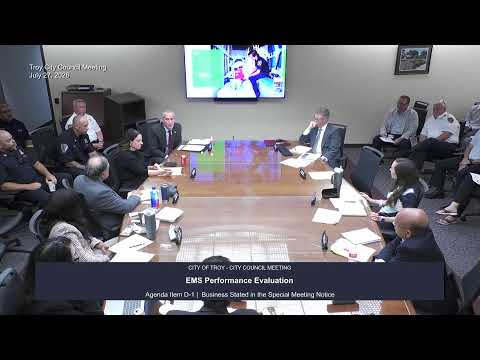
Council questioned whether the city could do EMS dispatching; communications manager Sam Kale said EMD requires initial 72-hour training, ongoing QA and continuing education, and radio/ interoperability issues remain.
Council members asked whether Troy could improve total response time by bringing emergency medical dispatch in‑house. Sam Kale, the city communications manager, explained the requirements: initial Emergency Medical Dispatch (EMD) training is 72 hours and must be paired with a quality‑assurance program and continuing education. "There is QA objectives that you have to do and you have to meet in order to be a properly trained EMD facility," Kale said.
Kale and staff also noted operational hurdles beyond training: the city must verify jurisdiction for multi‑provider calls (Troy uses Star; neighboring Clawson uses Universal), and there are radio interoperability and encryption issues that complicate direct dispatching to provider units. Staff said both Star and Universal maintain EMD-certified centers that currently complete medical dispatch after the city PSAP verifies call details.