Get Full Government Meeting Transcripts, Videos, & Alerts Forever!
Get email alerts on the Economic Development topic
No spam. Unsubscribe anytime.
Residents press county as MoonStar (Moonstone) Solar seeks tax-abatement review; court does not advance abatement
Summary
MoonStar Solar (Scout Clean Energy) filed a tax-abatement application proposing a 145 MW, ~$145M photovoltaic project in Wilson County. Public commenters raised water, visual, and economic concerns; company reps described technology and mitigation measures. The court found the application complete but took no motion to advance the development agreement at this meeting.
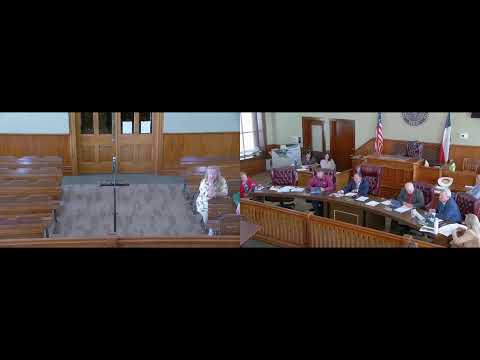
Representatives for MoonStar Solar (Scout Clean Energy) presented a county tax-abatement application July 27 for a proposed 145-megawatt photovoltaic facility southwest of US 181, and members of the public delivered extended comment expressing concerns about water use, landscape impacts, tax breaks and the possibility of later data-center development. Blakely Fernandez, counsel engaged by the county (Bracewell), described the application as complete under county policy and recommended proceeding with diligence and public hearings.
Fernandez said the project proposes a roughly $145,000,000 investment, a 1,400-acre project footprint inside a 3,600-acre proposed reinvestment zone, a 10-year abatement term under state law and a 30-year project life. "It's a 145 megawatt photovoltaic power generation facility... their investment is anticipated to be a $145,000,000," Fernandez said. She emphasized that the abatement under consideration would affect county maintenance and operations tax only and that overlapping jurisdictions (schools, ESDs, river authority) would continue to collect full tax rates.
Developer representative Evan Mallett of Scout Clean Energy answered technical questions: he said the project uses modern bifacial modules ("Series 7"), that agrivoltaics and sheep grazing have been used on other sites, and that permanent on-site Scout staffing would be low ("only about 3 plus" employees) with roughly 300 construction jobs anticipated. On water, Mallett said the project has not acquired water rights and that water use would be minimal outside temporary construction needs; he added the company would likely need water primarily for fire safety and limited dust control.
Public speakers urged conditions or delay. John Doyle told the court he "vehemently oppose[d]" incentives for very large projects and questioned offering tax breaks worth a large share of property value; Debbie Segovia asked the court to require setbacks (she requested 450 feet), native seeding, erosion control, decommissioning bonds and a citizens review committee. Kaye Love asked the court to "table" the item until the public could be made aware of project links to the county Economic Development Corporation and to confirm compliance with open-records and open-meetings laws.
Fernandez and staff described a multi-step process if the court chooses to proceed: public hearings on a proposed reinvestment zone (she suggested an August 10 public hearing) and a subsequent posting of a draft abatement agreement seven days before consideration. Staff said the contract can mirror state decommissioning requirements and include clauses to prevent conveyance to tax-exempt entities and to create recapture remedies for material defaults. Despite those assurances, when the judge asked for a motion to accept the development agreement/application (item 9.2), no commissioner moved and the motion died for lack of action.
Key project figures announced to the court included the project capacity (145 MW), estimated investment ($145 million), proposed project life (30 years), proposed abatement term (10 years), project acreage (about 1,400 acres) and a pilot payment example of about $142,794 per year to the county under one scenario. Fernandez and Mallett emphasized that detailed engineering, drainage, and environmental study work would be part of diligence prior to any agreement.
The court did not vote to proceed with the development agreement at this meeting; staff said the application is on file and that the next formal steps would include public hearings and additional negotiations.