Get Full Government Meeting Transcripts, Videos, & Alerts Forever!
Get email alerts on the Wastewater Costs topic
No spam. Unsubscribe anytime.
Sandy faces $134M—195M trade-offs on long-term sewage solutions
Summary
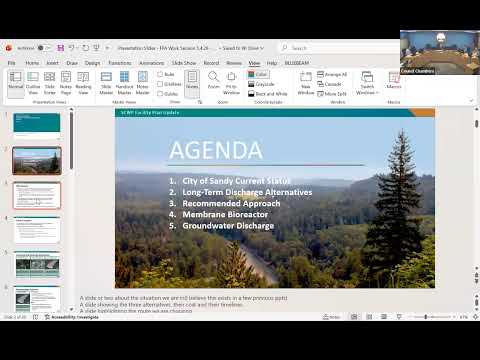
Commissioners heard multi-option cost and schedule estimates: groundwater injection ($134—147M, 4—7 years), a pipe to Gresham ($184—195M, ~4 years), or Sandy River discharge (~$165M, 6—8 years). Staff emphasized permitting uncertainty and operational tradeoffs.
City staff presented comparative cost and schedule ranges for three long-term wastewater strategies. AJ Thorn said the Sandy River option could take six to eight years and cost roughly $165 million; a regional pipeline to Gresham was estimated at $184 million to $195 million with an expected four-year construction window; the proposed groundwater-injection approach was estimated between $134 million and $147 million with a 4—7-year implementation horizon.
Thorn told the commission that the Gresham pipeline costs rose significantly once planners included a redundant force main to avoid a single point of failure. He said permitting and the level of required polishing for groundwater injection are key variables that drive cost and schedule uncertainty. "We expect that to be somewhere between 4 and 7 years," Thorn said of the groundwater solution, adding that state permitting guidance will determine polishing requirements and possibly additional capital work.
Commissioners pressed staff on lifecycle questions and whether options could be phased to unlock capacity sooner; staff said installing an MBR and related upgrades is phase 1 across multiple execution paths and that milestone completion could trigger unlocking additional ERUs under the consent decree.