Get Full Government Meeting Transcripts, Videos, & Alerts Forever!
Get email alerts on the Wastewater Groundwater topic
No spam. Unsubscribe anytime.
Public works director outlines groundwater-injection option as part of Sandy's wastewater plan
Summary
City public works director AJ Thorn presented a wastewater facility plan amendment that adds groundwater injection as a lower-cost alternative to sending raw sewage to a regional plant or discharging to the Sandy River; staff estimated a 4—7-year timeline and said permitting uncertainty will shape final design.
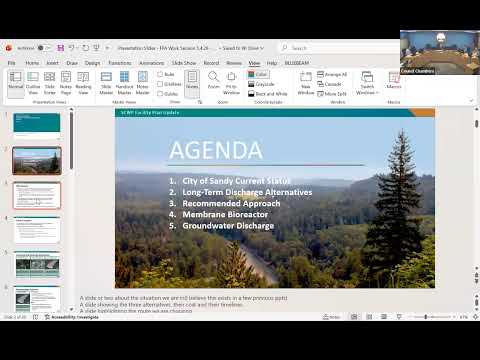
AJ Thorn, the city's public works director, told the commission the facility plan amendment adds a groundwater recharge (direct injection) option as part of a three-pronged discharge strategy alongside seasonal discharge to Tickle Creek and continued reuse with a nursery partner. Thorn said the groundwater choice became viable after House Bill 2069 encouraged wastewater effluent reuse statewide.
"We're going for every grant, every dollar," Thorn said when asked about funding strategies, adding the city is pursuing federal and state funds to reduce rate impacts. He said the groundwater-injection approach would likely require additional polishing to raise current class B effluent toward an 'A+' standard and that the level of polishing will depend on permitting requirements.
Thorn described an operational approach in which the city would continue nursery reuse when permitted and discharge to Tickle Creek seasonally; groundwater injection would be used in shoulder seasons or when other routes are unavailable. He emphasized technical steps still required: hydrogeologic drilling, travel-time studies to test for "functional equivalence" (whether injected water reaches the creek within six months), and iterative permitting with DEQ. Thorn cautioned that because the city would be among the first in Oregon to pursue injection, the timeline is uncertain and will depend on regulatory guidance.
The commission asked for follow-up on monitoring needs, filtration technology choices, and community outreach before any formal adoption. Thorn said staff aimed to present a final plan for adoption on June 1 and invited commissioners to schedule an on-site plant tour.