Get Full Government Meeting Transcripts, Videos, & Alerts Forever!
Get email alerts on the Wastewater topic
No spam. Unsubscribe anytime.
Council hears plan to pair membrane bioreactor with groundwater recharge as lowest-cost wastewater path
Summary
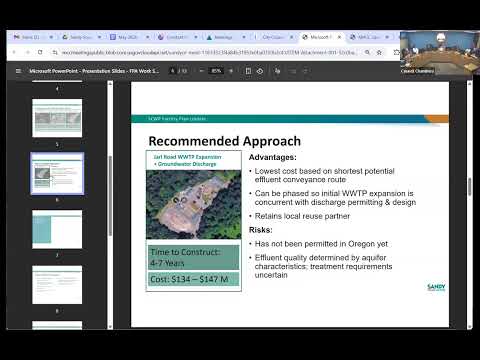
City staff recommended a phased membrane bioreactor (MBR) expansion plus groundwater recharge as the preferred facility-plan amendment, estimating $134–147 million and a 4–7 year timeline; staff highlighted permitting uncertainty as the key risk.
City staff presented a facility-plan amendment that would build a membrane bioreactor (MBR) at the wastewater plant and add a groundwater recharge (direct injection) option as the city’s preferred long-term discharge approach.
AJ, the staff presenter, said the groundwater recharge alternative is the least expensive of three options studied and can be phased. "This is the first time this will be done in Oregon," AJ told council members, noting the Department of Environmental Quality (DEQ) has not yet issued a permitting precedent for the approach.
Staff compared three approaches: a Sandy River outfall (estimated $165,000,000; 6–8 years), conveyance to Gresham (estimated $184–195,000,000; ~4 years but with uncertain connection fees), and the groundwater recharge option ($134–147,000,000; 4–7 years). The figures exclude about $40 million already invested and an additional $14 million the city still plans to spend on collection-system (inflow and infiltration) repairs regardless of the chosen alternative.
Officials said the MBR work would be the first construction phase and would allow the city to retain its summertime reuse partner and use gravity discharge when available; groundwater recharge would serve as a safety valve during “shoulder seasons” when reuse partners or creek discharges are not viable. Staff signaled additional technical steps—geotechnical studies, permitting work with DEQ, and an RFP for MBR design consultants as early as July 1—would follow if the council adopts the amendment.
Council members raised questions about the nursery partnership that receives reuse water in summer and asked staff to strengthen contractual protections (first-rights, long-term lease or similar) before investing in infrastructure dependent on that arrangement. AJ said the city will prioritize early engagement with DEQ and EPA to address permitting questions and to quantify the city’s recent inflow-and-infiltration reductions as evidence in those conversations.
The council will consider the facility-plan amendment for adoption at a scheduled hearing; staff also announced a public open-house event in two weeks for broader community input.