Get Full Government Meeting Transcripts, Videos, & Alerts Forever!
Get email alerts on the Utility Finance topic
No spam. Unsubscribe anytime.
Consultant’s WaterWorth model shows steep near-term rate increases needed to restore water fund cash
Summary
A WaterWorth financial model presented to the Brainerd Public Utilities Commission showed the water fund risks remaining below a six‑month operating reserve without multi‑year revenue increases and highlighted $60M+ capital needs for a new water treatment plant and other projects.
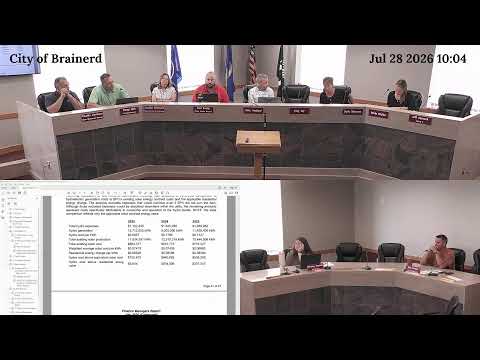
Adam Duddy of WaterWorth demonstrated a live, multi‑year financial model for Brainerd’s utility funds and told the commission the water fund’s cash balance will not recover above a six‑month operating threshold without revenue adjustments or new funding sources.
"Historically from 2024 to 2026 there hasn't been a lot of cash in the fund," Duddy said, noting that under a baseline projection the cash line remains below the red dotted six‑month threshold through the forecast. He highlighted major capital costs driving the gap: a reclamation/backwash project (~$5.3 million), Highway 10/Washington Street improvements (~$4.0 million), an anticipated new water plant (roughly $60 million) and an annual $2.6 million lead service‑line replacement program.
The presentation included revenue scenarios that would restore reserves. In one model staff showed large, near‑term increases (residential increases modeled at about 35% in 2027 and 30% in 2028, with smaller increases thereafter; commercial and city sales were modeled with an initial 40% increase). Duddy also walked commissioners through a phased alternative that staggers smaller percentage increases over a longer period and noted that rate design could soften impacts for low‑use or low‑income users.
Staff and commissioners discussed grant assumptions and model sensitivity. Paul (Public Works) and Danny Locke (staff) emphasized the tool’s value as a budgeting and public‑education resource; Paul said staff will use it to explore capital‑planning options that might reduce the need for abrupt rate jumps. Commissioners asked about opportunities to share projects with nearby jurisdictions and to identify grant or bonding options before adopting large increases.
The commission asked staff to refine the rate study inputs and return with recommended, more detailed rate options in time for the 2027 budgeting process.