Get Full Government Meeting Transcripts, Videos, & Alerts Forever!
Get email alerts on the Utilities Rates topic
No spam. Unsubscribe anytime.
Warrenton approves readings on water, sewer, sanitation and recycling rate changes and adopts public safety fee ordinance
Summary
The commission moved forward on annual utility rate adjustments (water +4%, sewer +8%, sanitation and recycling adjustments per staff/Recology) and adopted an ordinance establishing a commercial/industrial public safety fee; staff and Recology spoke to CPI, fuel and service drivers.
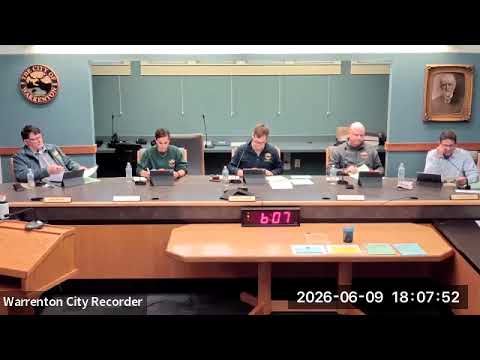
The Warrenton City Commission considered a package of annual rate adjustments and a new public safety fee ordinance affecting commercial and industrial accounts.
Public Works staff presented the annual water-rate adjustment of 4% and the sewer-rate adjustment of 8% as routine annual updates. The sanitation increase (cited from an HDR rate study) and recycling rate adjustments were discussed at length. Recology Northern Oregon representatives Dan Blue and Chris Carey explained the recycling adjustments (2.1% for residential curb recycling; 3% for other services) as CPI-driven and tied to fuel and labor costs. "This is a CPI-driven adjustment," Dan Blue said, noting year-over-year CPI near 3.5% and that the proposed adjustments come in slightly below that number.
Commissioners discussed customer communication and outreach; staff agreed to prepare explanatory information for the city website rather than a mass mailing given the costs. Commissioners and staff also discussed sharps/med-waste disposal costs and the countywide context for that service.
On a separate item, the commission held a second reading and adopted Ordinance No. 13-02 establishing a public safety fee targeted at commercial and industrial customers based on meter size. Commissioners clarified that residential meters would be screened out of billing lists and not assessed the fee. Because city code requires ordinances to take effect after 30 days unless an emergency is declared, staff agreed to adjust the implementing resolution's effective date to align billing and ordinance effective dates in subsequent action.
Several rate-related resolutions were advanced by motion or first-reading as required by charter and code; staff will bring back a second reading of the public-safety-fee resolution to set rates and effective dates in alignment with ordinance timing.