Get Full Government Meeting Transcripts, Videos, & Alerts Forever!
Get email alerts on the Genesys Partnerships topic
No spam. Unsubscribe anytime.
DOE panel highlights partnerships behind Genesys mission to accelerate AI‑driven science
Summary
Department of Energy officials, national lab directors and industry partners outlined how coordinated partnerships — combining national labs, universities and private firms — are intended to speed scientific discoveries through the Genesys mission.
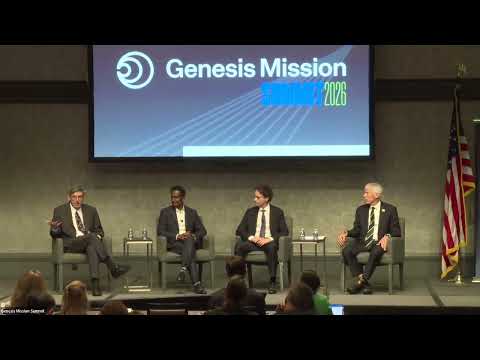
Secretary Wright convened a panel of national‑lab and industry leaders to discuss the Department of Energy’s Genesys mission and the role of cross‑sector partnerships in accelerating scientific discovery.
"We need to move fast," the Secretary said as he framed Genesys as a mission that requires universities, labs and industry to work together. John Serrao, director of SLAC National Accelerator Laboratory and chair of the National Lab Directors Council, said the 17 national labs are aligning behind the initiative and that coordination across facilities is central to scaling projects announced earlier.
Panelists emphasized three ingredients they said are required for success: upgraded compute and shared infrastructure, accessible and governed data frameworks, and workforce development so researchers can apply new tools. Kartik Narayan of Google Cloud described a layered approach that combines hypercompute standards, data tooling and researcher enablement. "You need common tools and frameworks with which data can be shared," he said.
The session repeatedly returned to the question of measurable results: panelists argued Genesys should aim for demonstrable scientific outcomes and public benefits rather than experimentation for its own sake. The panel closed by emphasizing next steps to translate early proofs into reproducible, accountable research that the public can evaluate.