Get Full Government Meeting Transcripts, Videos, & Alerts Forever!
Get email alerts on the Platform Architecture topic
No spam. Unsubscribe anytime.
DOE panel says agent-driven 'flywheel' could accelerate Genesys science portfolio
Summary
Panelists leading the Department of Energy's Genesys mission described a platform that stitches AI agents, domain-specific models and experimental facilities into a feedback loop they called a 'flywheel,' and urged awardees to use the shared gear.doe.gov resources rather than duplicating tools.
The Department of Energy's Genesys mission panel outlined a vision in which AI agents, specialized models and experimental facilities are integrated into a shared platform to accelerate scientific discovery. Rick Stevens, a panelist leading platform work, said the core idea is to capture end-to-end agent behavior — inputs, outputs and artifacts — so agents can learn from each other's experience and iteratively improve. "That loop is what I call the flywheel," Stevens said, adding that his review of the portfolio suggested the work could be advanced by an "army of about 10,000 agents."
Panelists said the platform should reduce duplication across teams. "You should see it as the resource for you. It's the one-stop shop where you come to get your Frontier AI, to get the agent tools and capabilities," Brian Spears said, pointing attendees repeatedly to gear.doe.gov as the place to find tooling and guidance. Andy Schwartz of DOE's Office of Science provided scale: Phase 1 covers 278 projects and 342 institutions and teams will be measured on both scientific impact and AI approaches. "Phase 1 projects are expected to demonstrate research workflows that incorporate AI to accelerate scientific discovery," he said.
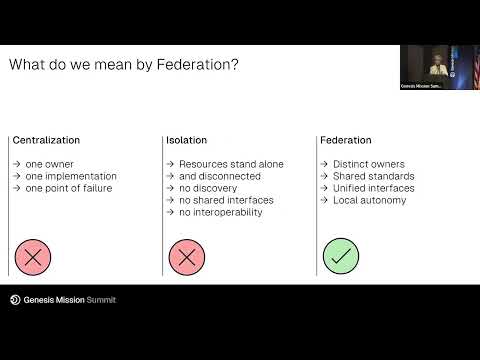
Why it matters: panelists framed Genesys as an 'Internet of science' — a federated, shared user facility that can give researchers access to otherwise scarce compute, instruments and software while preserving partners' autonomy. The approach aims to make incremental model improvements cumulative across the portfolio, speeding validation and follow-on experiments. Panelists urged awardees to engage with the platform and to feed back gaps and special requirements so the platform's technical teams can prioritize development.
Panelists also cautioned that the platform is not finished. Brian Spears called the current platform "completely and totally incomplete" and asked awardees to identify gaps. The DOE team said the next steps include forming working groups and collecting detailed community requirements to refine integration between DOE compute resources and AI subsystems. The Genesys platform, panelists said, will be iterated with user feedback rather than launched as a finished product.