Get Full Government Meeting Transcripts, Videos, & Alerts Forever!
Get email alerts on the Budget topic
No spam. Unsubscribe anytime.
May revise boosts Franklin-McKinley’s projected revenues; board cautions on one‑time funds
Summary
Assistant Superintendent Vaughn outlined the May revise impacts: a higher COLA lifted LCFF to about $87.2 million for 2026–27 and increased one‑time and special‑education funding, but staff warned the board about future drops when onetime funds expire.
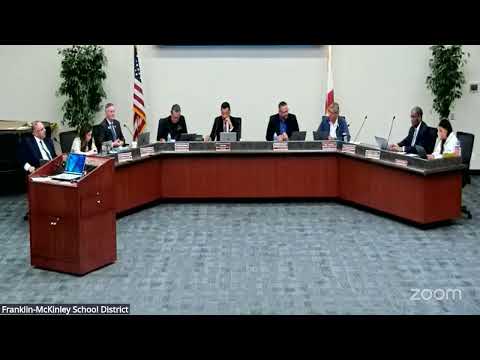
Assistant Superintendent Vaughn told the board the state May revise materially improved Franklin-McKinley’s near‑term fiscal picture: recent COLA changes and new proposed one‑time funds have raised the district’s LCFF outlook. "Our new LCFF revenue for fiscal year 26–27 is now $87,200,000," Vaughn said, and he highlighted large additions to one‑time discretionary block grants that raise projected ending fund balances for 26–27 to roughly $31.9 million.
Vaughn and trustees repeatedly cautioned that much of the increase comes from one‑time or restricted sources (literacy coaches, student support and professional development block grants, and special education increases) that will not fully recur. Vaughn quantified settle‑up impacts and estimates: the current settle‑up proposal would affect the district by about $635 per student (roughly $3.1 million ongoing). "We need to be cautious about how we spend these funds," he told the board, recommending the district reserve earmarked dollars for likely uses such as coverage for expanded leave and special education supports.
Board members asked how the district would track the effectiveness of new investments in special education and whether staffing assumptions aligned to enrollment projections. Vaughn described multi‑year projections that assume enrollment declines and recommended monitoring unrestricted reserves and staffing levels carefully; trustees asked that staff return with clear metrics tying investments to student outcomes before committing ongoing spending.