Get Full Government Meeting Transcripts, Videos, & Alerts Forever!
Get email alerts on the Management Plan topic
No spam. Unsubscribe anytime.
Conservation commission recommends Andrews Community Forest plan with refinements after split public feedback
Summary
After hearing split public feedback on recreation versus conservation, the Richmond Conservation Commission voted to recommend the Andrews Community Forest draft management plan to ACFC with suggested edits including a resiliency paragraph, glossary, clearer buffer rationale and accessible FAQs.
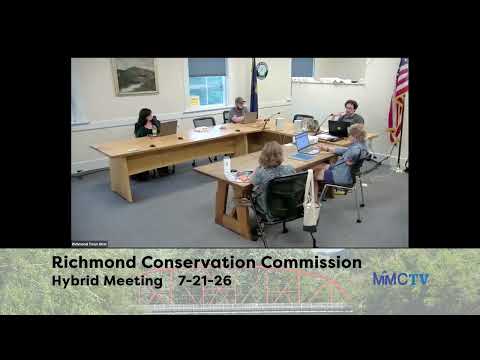
The Richmond Conservation Commission voted unanimously July 21 to recommend approval of the Andrews Community Forest draft management plan (MP2) to the Andrews Community Forest Committee and the select board, while asking for specific refinements before final adoption. Chair said public feedback at a recent select-board-hosted session was sharply divided between conservation-minded residents and those prioritizing recreation, and that the commission would compile responses for ACFC and the select board.
"It seems like the plan is more popular with folks who are looking for conservation in the forest and that folks that are looking for recreation are less in favor," the Chair said, summarizing the public feedback and the commission's next steps. Commissioners emphasized clearer communication to help residents understand what the plan permits and discourages — for example, that the draft does not categorically forbid new trails in the northern forest but discourages mountain-bike–style singletrack there.
The motion the commission approved asked ACFC to consider four refinements: (1) add a brief climate-resiliency paragraph in the ecology section, (2) include a short glossary of technical terms, (3) carry accessible language and a concise vision statement through the FAQs, and (4) provide a clearer explanation of buffer-width rationale. Commissioners also urged monitoring and baseline data collection for wildlife and trail use so future adjustments can be evidence-based.
Members agreed to collect edits on the draft RFP for invasive-species work and to place both an herbicide-policy round-robin discussion and RFP review at the top of the next meeting agenda. The commission set a deadline of 07/28 for written comments on the RFP to be submitted to the member coordinating edits.